Constitutional justice (in particular concerning the European model of constitutional review) is a part of the political system and its basic function is to protect the socio-political relations determined by the Constitution, whose legal basis is dependent on different systems of constitutional review. For the implementation of constitutionality and legality, appropriate social and political guarantees are necessary242. Only once the appropriate social conditions are fulfilled, does the judicial review of constitutionality become reasonable and important, because only then can constitutionality be implemented also by legal remedies. Constitutional review is as such a legal form which attempts to assure the consideration of the Constitution by repressive remedies. In comparison with other legal remedies, constitutional review protects and implements the Constitution as the highest legal and political act. Therefore, constitutional justice is the highest protector of constitutionality. As such, it is not a part of the ordinary judiciary. It is a special institution which can not be identified with the judiciary, legislature or with some other legal activity. Constitutional justice has a special function which is of a legal and political nature. Its aim is, in case of necessity, to (indirectly) assure the basic rights and freedoms of humans and citizens by repressive remedies. Constitutional justice is a part of the political system which endeavours to protect in a legal form basic sociopolitical relations. Therefore, constitutional justice differs from the judiciary in that it has a completely different function - i.e. protection on the grounds, i.e. the Constitution, of a given social and political order. Constitutional justice and review can act only within a stable social and political system, where the social forces are ready to respect the decisions of bodies exercising the judicial review of constitutionality. Although constitutional review is fundamentally of a repressive character, it may have a preventative function within a stable political system. Simply the existence of constitutional review should influence the consideration of the Constitution.
Theory distinguishes wider and narrower senses of constitutional review. Constitutional review in a wider sense of the word means the deciding of constitutional disputes in a judicial form with the aim to protect the Constitution. In a narrower sense of the word, constitutional review is an evaluation of the conformity of statutes with the Constitution, i.e. the review of the constitutionality of statutes. Constitutional review can act only within the system of a compact (rigid) constitution. If the Constitution may be changed only by ordinary statute, ie. by ordinary legislative procedure, the judicial review of constitutionality would be without sense. The more the Constitution is compact (rigid) the more it corresponds to the judicial review of constitutionality.
It is possible to speak about "real" constitutional review when the material meaning of constitutionality is taken into consideration. Constitutional review reflects the realization that legislative bodies can also violate the basic rights of humans and citizens. Therefore, constitutional review is closely bound with the consideration of such rights.
The Constitution is a basic legal and political act. Therefore, constitutional disputes are legal concerning form, and political concerning contents. Because the Constitution is a legal and political act, it is clear that the protection and implementation of the Constitution is a basic question of every democratic political system. The basic function of constitutional justice is the protection of the Constitution. In this function constitutional justice also reviews the activities of legislative and administrative bodies. This role of constitutional justice necessarily has a political nature. The specific nature of constitutional justice is reflected in the possibility of reviewing legislative and administrative bodies.
Constitutional review may not contradict itself. Therefore, the bodies that carry out judicial review of constitutionality must consider some unwritten rules. Among others, these include that the constitutional review of the constitutionality of statutes must interpret the Constitution in accordance with valid social and political principles. In addition, the Constitutional Court must equally evaluate the unconstitutionality of statutes form the point of view of the contents as well as from the point of view of formal constitutionality. The basic principles and the basic rights are the framework which determines the competence of the legislature. Consequently, the Constitutional Court is bound by basic human rights, although it protects these rights indirectly when evaluating the conformity of a statute with the Constitution. Such conformity has to be material and formal. Constitutional review is, when necessary, the instrument of the rule of law. Furthermore, the rule of law involves the consideration of individuals as the subject of the political system, as well as constitutionality as a historically introduced political and legal category.
The basic function of the judicial protection of constitutionality is to decide if statutes and executive regulations are in conformity with the Constitution. Therefore, the interpretation of the Constitution is the basic activity of bodies exercising the judicial review of constitutionality. This interpretation entails a comparison of two regulations which are on different level of the legal hierarchy, i.e. a comparison of a lower regulation with a higher one. The basic aim of such interpretation is to give or to determine the appropriate meaning (the contents) of constitutionality as concerns a concrete case, however, having an erga omnes effect. This comparison involves the comparison of the contents and the form.
Constitutional review in the world has reflected and still reflects different social and political interests, depending on particular social and political relations within concrete political systems. Therefore, it is impossible to speak about a certain positive or negative function of this institution. In any case, the function of constitutional review is the protection of social and political regulation. Constitutional review is a legal remedy, by its contents and consequences it can intervene into political circumstances. It may be taken to be one of the most important guarantees for the secure stability of a particular political system, because it potentially limits the self-interest of the highest bodies of authority, in particular the legislative, executive and administrative branches.
The system of constitutional review can function efficiently and completely only if certain prerequisites are available. Some of those are:
The guarantees of supremacy of the Constitution have to be embedded into the Constitution itself. The constitution has to take possession of a necessary and sufficient system of intra-constitutional self-preservation. In other words, any system has to be provided with an adequate immune system intended to preserve the functional integrity of this very system.
With regard to the methodological position stated, we shall try primarily to identify the logic of improvement of the Constitution itself using the example of the Republic of Armenia. We think that it is necessary to identify three basic levels:
Constitutional review will in turn inevitably get into controversy with social experience, if it is aimed at ensuring the supremacy of the subjective rights of authorities, rather than of the natural human rights and freedoms. In regard to this, we think that the first paragraph of Article 6 of the Constitution ("in the Republic of Armenia the Supremacy of statute is guaranteed") is to read as follows: "in the Republic of Armenia the Supremacy of law is guaranteed". Moreover, Art. 15 is to be amended as follows: "The natural and inalienable human dignity is the source of human and civil rights, and the people and the state in the administration of power are restricted by these rights and freedoms as by a directly acting law". This fundamental approach is to be materialized in all basic sections of the Constitution.
The issue of separation of powers is of fundamental importance. This issue became the subject of a special discussion at the session of the Constitutional Court of the Republic of Armenia when hearing the case "On the conformity of Article 24 of the Telecommunication Act of the Republic of Armenia of the Constitution of the Republic of Armenia".
The precedent for the case hearing was the appeal by 72 deputies of the National Assembly of the Republic of Armenia to the Constitutional Court.
The appellant party thought that Article 24 of the Telecommunication Act of the Republic of Armenia was not in conformity to the Constitution of the Republic of Armenia, in particular, to the provisions on the state-guaranteed freedom of economic activity and free economic competition registered in Article 8 of the Constitution of the Republic of Armenia.
The respondent party thought that the noted regulation of the Law does not contradict the Constitution of the Republic of Armenia, since the issue concerns a natural monopoly, and restrictions on free economic activity in telecommunications are intended to improve the communication situation on the territory of the Republic and to ensure technical advancement in this field.
The legal analysis of the provision of Article 24 of the Act shows that the legislator has established not an all-mandatory regulation adjusting the legal relations, but actually, ratifying the license terms established by the executive authority for a concrete legal entity, lent those regulations the force of Law.
Moreover, by stipulating in Article 24 of the Telecommunication Act of the Republic of Armenia that "The effect of rights established by the said license must be ensured by the legislation of the Republic of Armenia (including the antitrust legislation)" (this type of legislation were totally absent at the moment of adopting this Act), the legislator actually, while lending the legal regulation the features proper to a constitutional norm, had anticipated the concept of laws to be adopted for regulating this sphere.
According to Part Three, Article 62 of the Constftution of the Republic of Armenia, the powers of the legislative body are established by the Constitution, that has not lent the National Assembly of the Republic of Armenia the competence to adopt the organic (constitutional) laws containing the regulations of the constitutional type.
Moreover, according to Part Two, Article 5 of the Constitution of the Republic of Armenia, the state bodies and officials are competent to perform only the actions to which they are entitled by the legislature. The National Assembly of the Republic of Armenia has lent the force of Law to a document containing the regulations exceeding the competence of the Government or of the body empowered by the latter.
It was also underscored that according to Part Three, Article 8 of the Constitution of the Republic of Armenia, the state guarantees free development and equal legal protection to all forms of property, freedom of economic activity, free economic competition. Moreover, according to Article 4 of the Constitution, the state ensures the protection of human rights and freedoms on the basis of the Constitution and laws, pursuant to the principles and norms of International Law. Freedom of economic activity is not absolute freedom, it can be restricted according to the norms and principles of International Law, the type of restriction being substantiated by the legislator, with due consideration given to the fact that it is possible only for ensuring the relevant recognition and respect of rights and freedoms of other persons and for satisfying the rightful requirements of morality, public order and common welfare in a democratic society (Part Two, Article 29 of the Universal Declaration of Human Rights, item 3, Article 12 of International Covenant on Civil and Political Rights).
The principle of free economic competition, in turn proceeds from the principles of economic freedom and equality, and implies the equality of all economic entities of the market economy, ensuring by the state of equal conditions and opportunities for them.
Meanwhile, the analysis of the provisions of the Constitution of the Republic of Armenia, theanalysis of the constitutionality principles shows that the free economic competition does not exclude the types of activities prohibited by the state, subject to state licensing, activities that are natural or are state monopolies or are regulated by exclusive rights and intended to provide security or lawful interests of the state and society, public order, health and morality, rights and freedoms of other persons.
However, clarification of those spheres, possible restrictions of the degrees of freedom of economic activities or of free economic competition are regulated by the Constitution and by the laws for implementing the antitrust policies ensuring evenhanded competition as well as the economic and social advancement.
The legislative authority alone is competent to determine the limits and nature of these restrictions as regulations of all-mandatory behavior. And in case when individual legal relations are not yet regulated by Law, the Government can provide amendments not only as a subject providing the legislative initiative, but also based upon Article 78 of the Constftution, whereby with the purpose of legislative support of the Government activity program, the National Assembly can authorize the Government to adopt resolutions that have the effect of law that are in force within the period established by the National Assembly and cannot be contradictory to laws.
Thus, the Constitutional Court of the Republic of Armenia ruled that Article 24 of the Telecommunication Act of the Republic of Armenia does not conform to the requirements of Articles 5 and 8 of the Constitution of the Republic of Armenia inasmuch as the clarification of the types of activities subject to state licensing, being a state or natural monopoly, implementation in these spheres of antitrust policies, and with regard to security and lawful interests of the state and society, purposes of protecting the rights and freedoms of other persons, the possible limitation of the degree of freedom of economic activitiy and free economic competition as the norm of all-mandatory behavior had been previously established by the executive authority rather than by the law, while the legislator, in the form of transitional provisions lent the force of law to the stipulations targeted at a concrete legal entity, which stipulations contain language not conforming the Constftution of the Republic of Armenia.
Practically, the decision of the Constitutional Court, through interpreting the constitutional provisions specified the framework of the competence for the legislative and executive authorities with regard to a particular concrete law or government resolutions. At the same time, to avoid the practical disputes on constitutional competence or to minimize them, it is necessary to resolve the problem of separation of powers.
The issues of constitutionality of regulatory acts with regard to adjusting free economic activities are often dealt with in the experience of constitutional courts of the New Independent States. There is an interesting experience in today's Russia. An example would be the Constitutional Court of the Russian Federation having examined the case on reviewing the constitutionality of individual provisions of Paragraph 6 Article 6 and Paragraph 2 Part 1 of Article 7 of the Law of the Russian Federation On Operating the Cash Machines for Monetary Exchanges wfth the Population, stated in its decision of May 12, 1998 that according to a provision contained in the particular Law, the tax authorities are under an obligation to put fines upon the companies and upon natural persons guilty of violating this Law and this provision on using the cash machines when implementing monetary exchanges with the population as provided by the particular Law. Pursuant to paragraph two of part one Article 7 of the Law, a company having monetary exchanges with the population without using a cash machine is to be fined 350-fold to the minimum monthly wages established by law. The appellants think that the norms disputed by them violate the principle of equality of all before the law and the court, as well as the constitutional guarantees and the property rights, the right for legal defense and the right for an unhindered usage of one's abilities and property for entrepreneurial activities or other activities not prohibited by law, and so, they contradict the Constitution of the Russian Federation including its Articles 19 (part 1), 34, 35, 45, 46 and 55 (parts 2 and 3). The Constitutional Court also stated that it follows from Article 118 (part 2) of the Constitution of the Russian Federation, stating that the judicial authority is implemented by the constitutional, civil, administrative and criminal judicial proceedings, that the judicial proceedings on cases associated with examining the actions envisaged by the challenged provisions, have to be the administrative proceedings independent of whether they are examinedby a court of general jurisdiction or by a court of arbitration. Consequently, the preliminary proceedings will be the same, i.e. administrative, as well as the proceedings in cases when the decision making actually belongs to the bodies of executive power entitled with the relevant competence. Moreover, classifying a specific violation of certain rules in the sphere of economic activity, including the sphere of trade and finances, as an unlawful action, namely as an administrative offense, and, in view of the need for applying the relevant measures of state enforcement in the form of administrative responsibility, the legislator has to observe the relevant requirements of the Constitution of the Russian Federation.
The Constitutional Court has underscored that according to the Constitution of the Russian Federation, guaranteed in the Russian Federation is the freedom of economic activity (Article 8, Part 1); everyone has the right for a free usage of one's abilities and property for entrepreneurial or other economic activity not prohibited by law (Article 34, Part 1); the right to private property is protected by law (Article 35, Part 1), and one can not be deprived of one's property other than by a court decision (Article 35, Part 3).
It was also underscored that the right to private property and freedom of entrepreneurial and other economic activities not prohibited by law can be restricted by law. However, both as the possibility of restrictions and their nature are determined by the legislator in accordance with the Constitution of the Russian Federation, rather than arbitrarily, Article 55 of the Constitution stating that human and civil rights and liberties may be restricted by the federal law only to the extent required for the protection of the fundamentals of the constitutional system, morality, health, rights and lawful interests of other persons, for ensuring the defense of the country and the security of the state. This constitutional provision is in correspondence with the rules of international law, providing that while exercising his rights and freedoms an individual has to be subjected only to such restrictions that have been established by law and are necessary in order to ensure the due recognition and respect of the rights and freedoms of other persons, to preserve the state (national) security, territorial integrity, public (social) order, prevention of crime, protection of health or morality of the population (good morals), to satisfy the rightful rules of moral and commonwealth in a democratic society and compatible with other rights recognized by these norms (item 2, Article 29 of the Universal Declaration of Human Rights, item 3 Article 12 of the International Covenant on Civil and Political Rights, item 2 Article 10 and item 2 Article 11 of the European Convention on Human Rights and Fundamental Freedoms, as well as item 3 Article 2 of the Fourth Protocol to that Convention). Within the meaning of Article 55 (part 3) of the Constitution of the Russian Federation, with regard to the general principles of law, introducing the responsibility for administrative violations (nonuse of cash machines in violation of the rules of trade and financial accountability) and establishment of specific sanction restricting the constitutional law, is to meet the standards of justice, to be commensurable with the constitutionally registered objectives and with the guarded lawful interests, as well as with the nature of the action perpetrated.
The Constitutional Court also established that the establishment of the undifferentiated amount of a fine by the legislator for the nonuse of cash registers when effecting monetary exchanges with the population, impossibility of its reduction do not enable this sanction to be applied with regard to the character of offense perpetrated, the amount of inflicted damage, the degree of guilt of the offender, his property status and other meaningful details of the act upsetting the principle of the punishment to be fair, individualized and commensurable. Under such conditions the fine of this size for this type of offense can be transformed from a measure of restraint into an instrument of suppressing the economic autonomy and initiative, excessive restriction of the freedom of entrepreneurial freedom and the right to private property.
With regard to a number of other provisions of this law, the Constitutional Court in its decision recognized the constitutionality of a provision contained in Paragraph 6, Article 6 of the Russian Federation Law of June 18, 1993 On Using Cash Machines in Carrying out Monetary Exchanges with the Population according to which the tax bodies have competence to impose files upon companies as well as upon natural persons guilty of violating this Law when effecting the monetary exchanges with the population.
Meanwhile, collection of fines from natural persons is done within a judicial procedure; collection of fines from legal entities cannot be done unconditionally without their consent.
At the same time, the Court recognized as not conforming to the Constitution of the Russian Federation, Articles 19 (Part 1), 34 (Part l), 35 (Parts 1, 2, 3), 55 (Part 3) the provision of Paragraph 2, Part 1 Article 7 of the relevant Law, according to which a company carrying monetary operations with the populations without using the cash machine are subjected to the fine to the amount of 350 minimal monthly wages established by law.
It was also established that subsequently, before the adjustment of this issue by the Federal Assembly in accordance with the Constitution of the Russian Federation and with regard to the decision of the Constitutional Court for committing the offence indicated in Paragraph two Part one Article 7 of the examined law, the fine is imposed to the amount stated in Article 146 of the Code of RSFSR on Administrative Offenses, ie. 50 to 100 minimal wages243.
The cited example also shows that when examining the constitutionality of regulatory acts of principal importance is the issue on separation of powers and retaining the balance of competence.
It is recorded in Art. 5 of the Constftution of Armenia that "The State Power is exercised in accordance with the Constitution and the laws, on the basis of the principle of separation of the legislative, executive and judicial powers". This type of formulation is not frequently used worldwide. In most countries the focus is upon the principle itself, rather than upon its effectuation, or the provision of separation of powers. For example, Art. 10 of the Constitution of the Russian Federation states that "The State power in the Russian Federation is exercised on the basis of separation of the legislative, the executive and the judiciary branches. The bodies of the legislative, executive and judiciary powers are independent".
Moreover, in the constitutions of many countries the focus is also upon the interdependence (Portugal, Art. 114), interaction (Moldova, Art. 6), coordinated operation and interaction (Kirgizstan, Art. 7), balance (Poland, Art. 10), balance (Estonia, Art. 4) of powers, etc. This type of approach seems more justified providing consistency in realizing the principle of separation of powers.
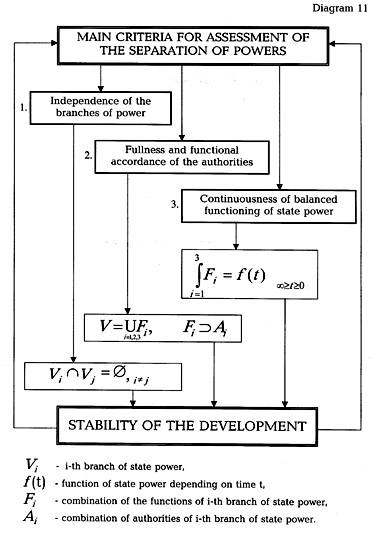
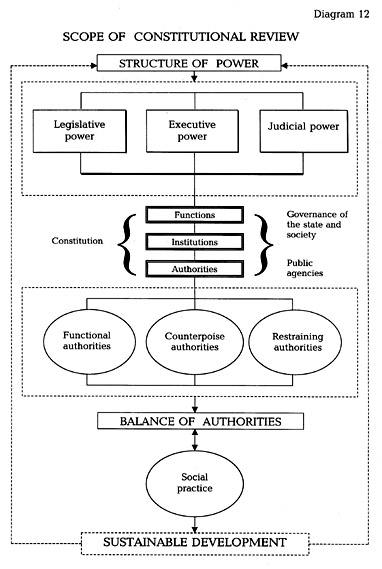
To uncover the contents of this principle from the vantage point of the constitutional review, the following question has to be answered: what are the criteria of the level of realizing this principle? (see Diagram 11). This question was in the center of a theoretical discussion at the International Seminar in YEREVAN, in October, 1998. Our position, approved by many participants of the seminar, particularly by Professors M. Lessage and D. Rousseau of France consists in providing the functional efficiency and independent realization of the separated powers, as well as the continuance and systemic balancing of the state power244. The problem consists in the very fact that each of the branches of authority has powers on the three levels (see Diagram 12):
The Constitution of Armenia has not provided solutions to many of these issues, which are in need of further development. That is primarily the case with the following issues:
The problem of securing the independence of the judiciary system needs particular attention. Art. 94 of the Constitution of the Republic of Armenia states: "The guarantor of independence of the judicial bodies is the President of the Republic. He presides over the Judicial Council". Experience shows that this type of formulation results in a distortion of the very concept of judicial independence. We think that there is a need for a new version of part 1 of this Article, viz.: "The guarantors of independence of the judicial bodies are the Constitution and the Laws of the Republic of Armenia". We also believe the logic of providing the judicial independence does not yield the situation whereby the President presides over the Judicial Council.
Awaiting their resolution are many questions associated with the organization of elections and electoral disputes. We suggest to introduce certain amendments to Articles 51, 100, 101 and 102 of the Constitution in order to provide a genuine support not only to the first round of voting and disputes' resolution within this round, but also to organize and carry the second round and the new Presidential election, as well as to comprehensively materialize the problem of resolving disputes on parliamentary elections.
Moreover, it is suggested:
- to provide the adoption
of the Constftutional Court Act,
- to amend item 2(1)
in Article 100: ... based upon an appeal
by the President of the Republic, by the National Assembly or by the Government, (the Constitutional Court examines cases on interpreting the Constitution with regard to disputes of the bodies of state authority on constitutional competencies);
- to state item 3 of this Article in the new version: "... resolves disputes associated with the resolutions on the results of referenda, elections of the President of the Republic and of the deputies";
- to state item 6 in the following version: "... provides definitions on the constitutionality of measures stated in items 13 and 14 of Article 55 of the Constftution";
- to indicate in Article 101 as possible appellants to the Constitutional Court: "The President, 1/5 of the members of the Parliament, the Government, the courts of general jurisdiction, the Prosecutor General - for abstract review, the elective bodies of local self-government, church, any natural or legal entities - for concrete review, candidates for the republican presidency and for deputies - for disputes associated with resolutions on electoral results", - to review Article 102 and state it in the following formulation: "The Constitutional Court carries decisions and findings within the order and terms provided by the Constitution and by the Constitutional Court Act.
The decisions of the Constitutional Court are final, not subject to review and enter into force at the moment of publication, however, the Constitutional Court can appoint another term for the regulatory acts' invalidation. This term cannot exceed twelve months, if it is a law, and six months if it is another regulatory act. In case of taking decisions associated with financial expenditures having no provisions in the budgetary law, the Constitutional Court determines the term for the regulatory acts' invalidation following a briefing with the Government.
The issues indicated in items 1-4 of Article 100 of the Constitution are resolved by the Constitutional Court's majority, while those indicated in items 5-9 and 211 - at least by two thirds of the members.
The bodies of state authority have no right to adopt resolutions countering the official findings of the Constitutional Court."
There can be no doubt that the issues discussed have a direct association with establishing a functional system of constitutional. review. Their resolution will however not fully eliminate the problem. Unfortunately, there is a confusion in Armenia between the two approaches to establishing the functional and the institutional bases of the constitutional review. Those two approaches are: the judicial constitutional review and the quasi-judicial preventive review. The need is ripe to introduce clarity into this issue which will certainly result in relevant amendments in the Republic of Armenia Constitutional Court Act.
Our proposals are intended to not only establish a reliable system of intra-constitutional self-protection, but also to consolidate the immune system of the public organism with regard to the fact that this system will be able to provide the stability and dynamic development, to properly uncover and overcome the disturbances of the functional balance, to prevent a massive buildup of negative social energy. We deeply believe that the efficiency of constitutional review is not determined by the number of submitted appeals or examined cases. The major criterion for assessing the activities of the institutes of constitutional review is the extent of the actual effect produced by their activity upon the social processes, upon the retention of constitutional balance of the societal equilibrium, upon sustainable development and the deepening of democratic processes in the society.
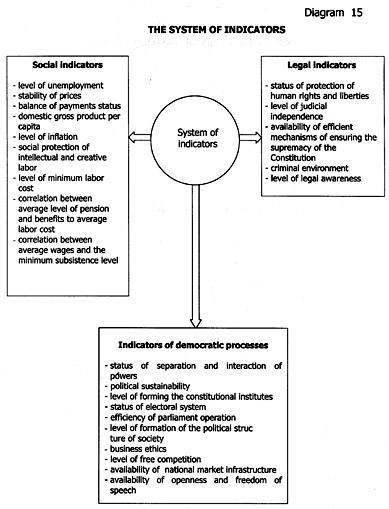
Of great interest is the problem of comparative analysis of the stability of the public organism and the mechanisms of the functioning immune systems in different countries. This problem is in need of special examination. However, our suggested methodical approaches to improving the system of constitutional review and consolidation of the immune system of the social organism can be very useful with regard to this issue. There are different approaches to the integral assessment of the stability of human development. The basic idea is that systems of indicators are developed on sustainable development245. The problem consists in developing an integral indicator of comparative evaluation of sustainable development with the generalization of economic, social, ecological, socio-political and other indicators.
In order to assess the sustainability of a social system, we think that a system of indicators is needed at the following levels:
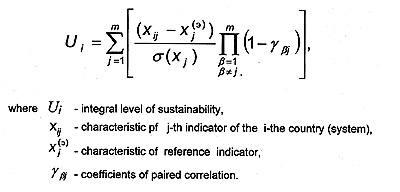
The suggested methods will also make it possible to resolve the issue on controlling the process, determining the effect of each indicator upon the integral level of sustainability.
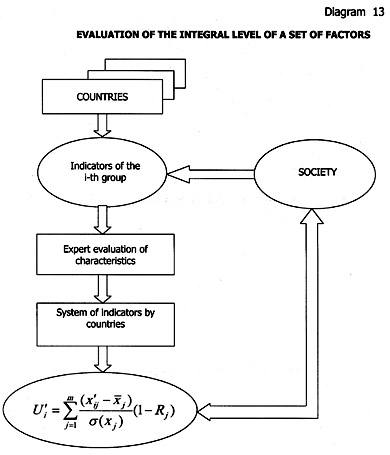
When determining the integral effect of certain sets of factors (social, legal, etc.) upon the development of society, this formula can be presented in the following form (see also Diagram 13):
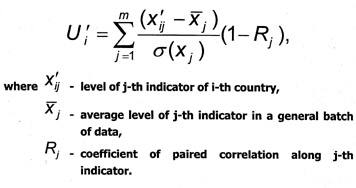
This formula enables us to put forward the issue of process controllability within individual sets of factors affecting the general level of social development.
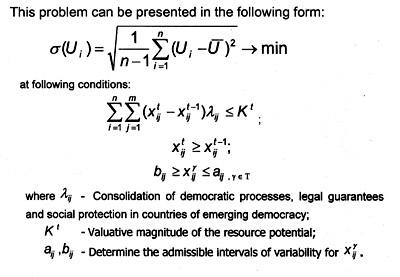
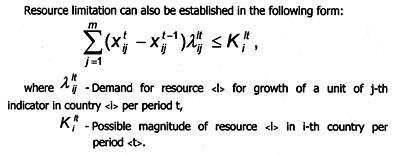
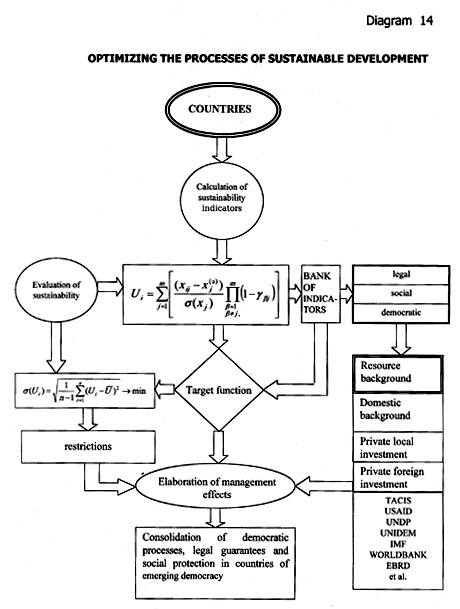
The proposed techniques of effecting the sustainability of social development also enable us to put forward a problem of optimal combination of individual groups of indicators. To be put into the basis of this approach is the requirement on a most expedient and rational usage of the capability to obtain a relatively maximal effect of ensuring the sustainable development (Diagram 14).
It is to be noted that comparative analysis assumes comparisons between the relevant characteristics of sustainability for both the countries of developed democracy and emerging democracy, then the target function of the problem can be presented in the form of reducing to minimum the difference between the integral indicators and the factor-by-factor indicators of individual countries. Naturally, we deal here with a very active consolidation of democratic processes, legal guarantees and social protection in the states of emerging democracy.
We have tested this method when evaluating the social, legal and democratic indicators of sustainable development in the countries of the former USSR. The integral indicator of sustainability is characterized as follows: Armenia - 0.44, Azerbaijan - 0.42, Belarus - 0.3, Georgia - 0.43, Kazakhstan - 0.48, Kirgizstan - 0.48, Latvia - 0.72, Lithuania - 0.69, Moldova - 0.5, the Russian Federation - 0.38, Uzbekistan - 0.37, Ukraine - 0.4, Tajikistan - 0.22, Turkmenistan - 0.33, Estonia - 0.78.
Calculations show that the highest level of sustainability is observed in the Baltic States, the sustainability indicator in Estonia being 3.5 times in excess of the one of Tajikistan, 2.6 times - Belarus, 2.1 - the Russian Federation, 1.8 - Armenia.
As to the established total picture in Armenia, it is as follows: in the integral indicator Armenia is behind six countries (Estonia, Latvia, Lithuania, Moldova, Kazakhstan, Kyrgyzstan). However, the social indicators are higher only in comparison with Tajikistan, and continue to go down. Still is not functioning a reliable system of social protection, preservation of social sustainability is provided mainly through the external factors, there is an ongoing devaluation of democratic values. The picture does not look so grim in the domain of legal indicators. Meanwhile, quite ripe is the problem of reforming the Constitution. There is a continued application of the three types of laws (laws of USSR, the pre-constitutional and those adopted after the Constitution), with the provisions often contradictory and countering the Constitution (see Diagram 16).
The results of a selective analysis have shown that of the 114 examined laws, 800 contain provisions contradicting the Constitution. Meanwhile, in the three years of its existence the Constitutional Court received only three appeals on the definition of the constitutionality of laws. That is the result, in the first place, of an unjustified contraction of the circle of persons having the right to appeal to the Constitutional Court. That is also the indicator that the immune system of the society does not efficiently react to the violations of the functional balance in the society.
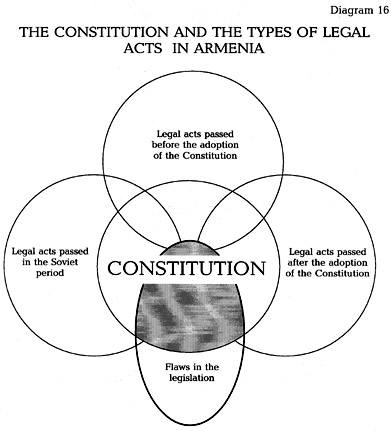
In the Republic there is no well-defined law-making policy, which results in multiple defects in legislature which in turn promote subjective and arbitrary behavior as well as an excessive tightening of the administrative leverage. The legal awareness of the population is at a very low level. The schools have yet to introduce the legal training. The new judicial system is still in the stage of substantiation.
The acting Constitution does not provide for the functional link between the courts of general jurisdiction and the Constitutional Court while implementation of constitutional review.
All of the above demonstrate that the efficiency of constitutional review in Armenia can be substantially increased if the problems pointed out find their systemic solutions and if the mentioned necessary and sufficient preconditions are met.
Both for Armenia and other countries of emerging democracy of great importance are the improvement and expansion of the international cooperation in this field rather than only the intrastate mechanisms of providing efficient activity of constitutional courts.
| Previous |