At the same time, the
adoption by a state of the Basic Law prompts a new approach essentially
demanding that the corresponding constitutional institution or a special
organisational reviewing structure be formed pursuant to the objectives
of the constitutional review. This, however, does not mean that the previously
operating forms are completely interrupted. On the contrary, the question
is that any country should use the multiple features to harmonize all components
with the purpose of retaining the legal system, common law, the way of
life and traditions, retain the spiritual and moral values. Only in this
case a multifaceted consideration of the basic characteristics of a particular
social system is possible, to establish an operational immune system for
its continuation and functioning.
a) The Character of Public Relations and the Constitutional Review
The experience of constitutional adjustment of public relations accumulated within the last two centuries shows that the main purpose of adopting state Constitution is regarded to be the discovery and maintenance of fundamental characteristics of public relations with the purpose of establishing a favorable environment for a full-fledged implementation of natural human and civil rights and freedoms. Apart from the fact that the constitutions of many countries characterise a particular state96 as secular the countries that legalised the principle of separation of powers, thus basically directly or indirectly established the provision that they are democratic, states governed by the Rule of Law and/or States of Social Welfare97. What is suggested by this feature, is how much is that regarded as a principle, purpose or a directly acting legal standard, and what tasks are posed before the constitutional review in the currently emerging legal systems?
The answer can seemingly be found by a multi-faceted analysis of those concepts as the categories determining the basic qualitative features of public relations, as well as by determining their manifestation in the trinity.
The meaning of any philosophical concept is in that it reflects the properties of a particular phenomenon (subject under study) each of which is necessary and, in its integrity, sufficient for the qualitative determination of the integrity of the particular phenomenon (subject), its recognition or distinction. The concept of CATEGORY is the generalisation of the highest degree, an abstract characteristic of the integrity of the particular phenomenon.
Independent of the level of our cognition, those relationships, in the presence of the necessary prerequisites, either do exist already or they emerge and act. How large is our knowledge of them, do we model them or provide them with the prescribed shape? The answer is dependent upon our knowledge, freedom of action and the capability to review objective processes. With regard to the measure of awareness and regulation of relationships, it can be perceived by the community as a mandatory rule of behavior. In other words, a legal standard is a characteristic of adjusted, somewhat regulated public relations. Since, however, those relations exist dynamically, the legal standard cannot manifest itself exclusively as a factual statement. It expresses the degree of potential cognition of these relations, the movement or target, the type of behavior in a variable situation, which has to be correlated with the system of constitutional review, its forms and methods.
This fact is of a special significance, since the social practice of a number of countries (in particular, Hungary, Croatia, Russia, etc.), in the transitional period, shows that if it is not seriously considered, it may result in serious in-depth controversies or deadlocks. It is essential here to adopt the truth that any constitutional standard, particularly in the course of radical reforms of public relations, is a fundamental principle, a guiding development factor. The constitutional review, in turn, at a constitutionally defined course, has to become an incentive for the development of society, rather than its break.
Guided by this methodological approach, let us try first to comment on the democratic, legal, and social character of the constitutionally established system of public relations.
Democracy, as a characteristic feature of public relations and as a method of administration, is perceived and commented differently, and is subject to frequent change, up to anarchy and total permissiveness (the problem is not only in perceiving the essence, but in the measure).
Democracy, as one of the greatest achievements of civilisation, bears witness to the formation of civil society, where each person becomes valuable as an intelligent being, as a social subject, as an equal member of the society98, where the relations are clarified and regulated, with an established order and rules of its maintenance, and the boundaries for civil liberties and autonomous behavior. That is the way of development for the state, having a way of state administration, structure and operation conforming to the will of the nation, as well as to the generally recognised standards of human and civil rights, where the nation is the power holder, wielding it through its collective will and its right for self-review, effected by the principle of equal rights of the members of society. That has to be enacted by the Constitution, guaranteed by the laws and by the substantive institutional systems.
Of major importance is the fact that on the part of the people, authority is exercised on the basis of the principle of continuity, under conditions of review over the activity of the representative and executive bodies, with a provision of feedback.
The major characteristics of this type of state are: a true representative democracy (legality, accountability, the status of feedback when implementing state authority by the population through elected bodies, guaranteed continuance of wielding the power by the people, as well as guaranteed protection of human rights (as a social value) and civil rights (with a citizen posing as the subject of law for the particular social formation). It follows that a state may be considered democratic where the society is built or is being built upon legislatively adjusted relationships, with guaranteed boundaries of natural self-expression and self-government of the personality, and where each person, without whatever selection, as a social subject, has public value, where, taken as the basis of social development, are the mutually settled interests of individuals, their state-coordinated groups and the society at large99.
A social system of this type is bound to be legal, while its democratic values are bound to have a guarantee of legal protection.
Characterised as a state governed by the Rule of Law is the state where all its activity is based upon the law, and its primary objective is a guaranteed protection of human and civil rights.
The concept of a "state governed by the Rule of Law" emerged at the turn of the 18-th century. However, the idea was there well before100.
The state governed by the Rule of Law primarily assumes a certain legal orderliness of public relations and their reliable, fail-safe, guaranteed operation. Only in this case the law subjects can be free. Only the awareness of the objective public relations, their legal regulation and knowledge enables a person to act freely (We have to be slaves to the law to be free - Cicero).
For the basic principle of a state governed by the Rule of Law is just the harmonic combination of subjective rights of the citizens and of objective prerequisites for their implementation.
Another characteristic feature of a state governed by the Rule of Law is that the state should bear responsibility for the actions of the officials, a guaranteed system of responsibility and review of the realisation of rights.
The mandatory features for the state to be described as legal are: separation of powers, legality of administration and supremacy of law101, independence of court, guaranteed protection of human rights, an integral operational system of constitutional review, etc.
Those qualities, being fundamental and essential, have to be absorbed by every cell of regulating the public relations, to be reflected in each step taken by the state, to become an inalienable component of the way of life for each member of society. It has to be transformed into the national state reasoning and manner of action. In other words, they have to find their reflection in each standard of the Constitution and in the mechanism of its application, as well as to make an adequate manifestation in social life.
The constitutional declaration of a state governed by the Rule of Law is primarily a testimony of the features of the character of the state and social relations; it is a manifestation of the organisational attributes of the state, evidence of the fact that this society has laid the law in its foundation of interrelations. This type of state confronts an objective to put the social behavior of the state and the society at the service of this principle, to clearly define for each individual the rules of behavior in a civil society and the confines of his or her freedom, as well as to guarantee this freedom.
It is indisputable that the Constitution of any country is regarded primarily as a fundamental legal document based upon social consensus. It is a certain generalised authentication of the forms and methods of approach, aims and principles. For any country, the Constitution becomes a source of law making, its embedded principles being not only statement of facts, but rather the fundamental rules of the manner of action. Those rules are related not only to the authorities, but also to each subject of the law, representing the state (whether it is a citizen or a group), becorrling their semblance, image and their contents of self-expression.
In a state governed by the Rule of Law, the social totality adopts a regulated image characterised as public order, while a person becomes a subject of the law, with its relations to other members of society assuming a character of legal relationships regulated in a certain way.
A society like this should inevitably also have a constitutionally adjusted system providing for a continuous review of legal relationships, which as has been noted, performs a role in the social organism of a specific immune system.
A great divergence in opinions is manifested in the comments to the concept of "a State of Social Welfare", particularly in the New Independent States. Serious problems emerge in the practice of constitutional review of the protection of human rights within the social sphere. Thus, we shall dwell upon them in more details102.
The concept of a State of Social Welfare emerged at the turn of the 19th century. It signifies the emergence of a state of new quality, a state that would undertake an obligation to take care about the social protection of its citizens. This type of quality is not typical of a liberal state governed by the Rule of Law, with its preferences to the manufacturing and to market freedom. However, from what has been said so far, it does not follow that in the liberal-state governed by the Rule of Law no social issues are advanced or resolved by the state.
The matter is that constitutional registration of the social character of state provides the whole social system with other contents103.
With regard to different interpretations of the term "social", when using the term "a State of Social Welfare", often suggested is the state that assumes responsibility for the dynamic development of society (in the particular case social means public)104. However, using the expression "welfare state" commonly suggests a form of the interaction with the mutually agreed human relations, where a commitment is made to help the needy, to affect the redistribution of worldly goods, on the strength of the principles of justice, so that everyone should receive the guarantee of a dignified life.
We think that to pronounce itself as a welfare state constitutionally, a state has not only to commit itself to harmonising the interests of persons, their groups and the whole society, to exclude their opposition and subjugation of one to another, but also to take measures for their consecutive implementation.
The highest attainment in manifesting the social humanism and the progress of civilisation is the establishment of the welfare state with the members of society defining the aim of their development through constitutional consensus, clarifying the correlation: objectives prerequisites - means. This is an elevated level of human interaction. A welfare state can be created over an established integral operational system of guarantees for the protection of human rights, where the whole system of state administration is based upon the principle of harmonically organised public interests.
A State of Social Welfare suggests an elevated level of harmonising the relationships between a person and the society, a person and the state. That has to find recognition, has to be perceived and protected by each cell of the society, it has to become a mandatory rule of behavior, so as to exclude all that is illegal, unjust and unfit to the humane principles of the common human existence.
This approach will make specific demands upon the system of constitutional review of a State of Social Welfare. Disregarding this situation can result in uncoordinated approaches by different bodies of authority to complex issues of communal development, and indirectly, in an unconstitutional situation. However, we think it noteworthy that State of Social Welfare needs a very flexible and complete system of constitutional review. That is corroborated in particular by Germany.
Often, the social function of the state is confronted with the function of ensuring the freedom of members of society, which, to our mind, is unjustified. Democratic liberties will also assume a guaranteed social protection of a member of society, which is one of the main characteristics of human society. Civil liberty is distinguished from the natural freedom by that the individual activity within the society should not be opposed to the right of freedom to other members of society. At the same time, as noted by Professor G. V. Maltsev, in a society, the interests of a personality are always variable. Not all of them can be mediated in special subjective rights: first, because the possibility associated with the subjective right to legally claim certain goods, actions of other persons, can be currently provided with regard to nearly none of the human interests; second, the capabilities of the legal system are limited in the sense of detailed regulation of individual interests: had the law expressed and regulated all interests of persons in special standards and rights, it would have been an extremely complex, vast system, quite unusable for practical applications. Therefore, subject to the legal regulations are only certain interests of personality, being crucially significant for all members of society105.
The civil society must have a harmonic system of free self-expression for its members. However, the latter is impossible without providing a state-secured protection of the members of society. That, in turn, means that a personality in a society cannot feel isolated, the natural state of its existence is mutual interconnection, interaction and responsibility before the present and the future society. Meanwhile, E. A. Lukasheva, Doctor of Law, rightly states that the currently existing vacuum is also theoretical: the post-Soviet society lacks the basic positions of relationships between the citizens and the state106.
This type of situation commonly results in the absence of clarity not only in today's responsibility of the state with regard to a member of society, but also for a citizen, in turn, it is unclear whether the state is capable to satisfy his or her aspirations, whether his demands and expectations are legitimate and substantiated107. That in turn, on the one hand, results in serious complications in the practice of constitutional review (all the more so when the citizen is not the subject appealing to the Constitutional Court), on the other hand, it is a powerful and perilous insinuative generating social dissatisfaction. Thus, while defining the priorities in state politics in a transitional period, a particularly important place should be allocated to the development and introduction of a very clear and accessible system of relations between the state and the citizen. The pivotal fact is that for the welfare state, the center of all those decisions is a man with his rights, state-recognized, constitutionally registered, necessarily guaranteed and protected, as well as with his responsibilities before the society.
It is our belief, that
of the basic characteristics of the welfare states, the following have
to be singled out:
a) to provide the
legislative guarantees of social protection and welfare of the people;
b) to establish the
necessary institutional systems of state and non-state social protection
(in particular, what is meant is the system of social security touching
upon the fateful cases like disability, disease, loss of the breadwinner
unemployment, insecure old age, etc., as well as the operational system
of social security adjusting the social risks);
c) to guarantee the
minimum living standard;
d) to provide guarantees
for the free development of personality, implementation of the freedom
of faith and interests, as well as the rational self-expression;
e) to guarantee irreversibility
of the implementations of this principle;
f) to provide constitutional
review for protecting the human rights and freedoms, etc.
It is to be noted that in the transitional period exceptional significance is given to the issue of protecting the socio-economic and cultural human rights as an important function of a State of Social Welfare. The matter is that in a transition to the market relations, when the market infrastructures have not yet been completely established, there is no distinct system of social protection, the rule of monopoly is going on in all spheres, serious in dept structural reforms take place, there is a feeling of traditional and psychological inertia, so that the inadequate market relations augment the potential of trampling the social and economic human rights. That is why the state has to take an active part in resolving the transitional objectives and to generate the necessary system of securing the protection of human rights, so that people with equal rights become carriers of new economic relations.
In the transitional period such a social-psychological situation is created, when the activity of any subject of law sanctioned by the state is identified with the state activity, and the attitude to that is regarded as the attitude to the state, with all the ensuing consequences.
Many thousands (in many countries - millions) cheated testify to that. One more testimony to that is that the state does not pay due attention to the issues of the ability of the review of transitional relations, no necessary system has been created to monitor the subjects of law, nor a system of human rights protection. The unfortunate situation is that such events not terminated in time are bound to become the origins of disease for the society. The blank spaces of the past, having inertial or dwindling character, are not so much unfavorable for the state but rather the lawlessness, that has manifested itself and found fertile soil in the new reality. The latter is very promptly entering into the pathway of irrational reproduction, so that it can be cured only by surgery. Unfortunately, that situation was in former times underestimated by many new independent states. The outcome is that in any situation, the state primarily takes care of preventing the immune -deficiency of the society, the important precondition whereof is systemic approach to the substantiation of administration mechanisms. We fully agree with the statement by prof. G. V. Atamanchook, that "efficiency of administration (any!) is not at all in advancing new problems all the time, nonetheless in an acute, dramatised, counteracting form currently practiced by the power holders and contenders. It is rather the contrary, for the very fact of the emergence of a specific problem, even not yet entering crisis, as shown by history, not always follows from the regular processes of development (development can also go on without tragedies), most frequently because the new needs, or interests, conditions or factors of social life had not been noticed in time"108.
Returning to the basic characteristics of a State of Social Welfare, it may be necessary to also note the principle of social equality, that during last two centuries is the core of revolutionary struggle. This quality has been perceived and interpreted from diametrically opposed positions. Frequently, the primitive, mechanical interpretation of the principle of social equality and its perception as the best measure of social justice results in a coarse and perverted interpretation of regularities, character and development of social relations. The indisputable truth is that, to produce social equality, the Socialist State fought against wealth for 70 years. A State of Social Welfare cannot eliminate the principle of equality of the members of society, however, this principle should not be considered absolute, but rather regarded as a right of each member of society, so that the state would produce the needed preconditions for the realisation of this principle. It also assumes that the state's duty is to guarantee groups an unbiased attitude to each member of society and to social and other groups. Actually, a State of Social Welfare, on the one hand will provide a certain environment of social protection, setting "the benchmark", on the other hand it has to establish a necessary environment, so that each individual, having equal rights, could obtain a relevant field of activity for a legal realisation of his or her capability and application of intellectual powers. Those are the provisions for the harmonic coordination of freedom and equality.
The basic principles of human coexistence - freedom and equality are fully combined in the trinity of democratic, legal and Social Welfare state. Any isolation or unilateral absolute prioritising or contradistinction of these qualities would be a methodological blunder and can result (as bitterly witnessed by history) in radical, distorted and, as a rule, inaccurate findings.
A State of Social Welfare, by assuming the commitments on the social protection of personality, has in the first place to be concerned with providing the premises for the self-cognition and self-expression of the rational being or the individual. However, the complexity of the issue is in trying to determine the limits of state interference into the economic relations of the society, so as to, on the one hand, guarantee the realisation of the state's social function, on the other hand, not to impede the natural development of market relations. This equilibrium should be ensured on the basis of a multilateral evaluation of each specific situation in each individual country. That is where the art of administration is. That is a basic measure of evaluating the activity of the government. The common features are that the State of Social Welfare has to take an active and programmed part in the system of social rehabilitation. That is related to production, and to turnover, and to distribution. The latter fact was particularly significant for Germany when it declared itself a state governed by the Rule of Law and a State of Social Welfare. As underscored by Hess Conrad, the State of Social Welfare not only implements a special preprogrammed policy in resolving individual social problems, but rather it is a managing, manufacturing and distributing state109.
The social character of the state is the principle, the objective and a directly acting legal regulation, that describes the substance of the varying social relations, and in those dynamic interrelationships it becomes the rule for the behavior of subjects in society.
The substantiation of a State of Social Welfare is a permanent continuous process demanding an adequate approach in any new, changing environment. It is a mistake to think that a state can be considered social only when the needed economic prerequisites have been created, so that the time has come to think about the social needs of the people. The issue of rightful combination of the people's needs and the abilities for their satisfaction is a dynamic phenomenon that is always present. Another point is that with different available capabilities resolutions can be made of different objectives for social contents. This does not, however, mean that within time and space, the method can be severed off the target, nonetheless to be opposed to it.
As to transitional periods, particularly in situations involving crises of administration, the issue of social protection in a state becomes a priority. Moreover, the European experience shows that the social function of the state has become more emphasised and constitutionally registered in the process of systemic reforms, since the top priority of those reforms is the man, the satisfaction of his needs, and, as figuratively noted, "the humanisation of society". Therefore, the basic objective of the state in a transitional period is counterbalancing the amplitude of transition to market relations using a reliable system of social protection. Otherwise, there is a danger of malformation, a threat to any economic reform, if the latter is aimed at creating a normal market economy based on sound competition.
Interesting in this sense is the German experience. Germany was the first to register constitutionally that it was a democratic and social federative state (Art. 20), and as such, it set the aim of the initial stage of developing the statehood to guarantee the cost of living to every citizen, assuming that each adult person had to work to provide for its needs. If that was impossible because of his or her working disability, the state assumed care for this person. Meanwhile, the state provided for the preconditions for self-expression of personality, mutual assistance, associations and joint activity.
Not a single state in the world can yet make a definite statement that it has become a full-fledged State of Social Welfare. That is a way to go or not to go, the state either assumes this function or it does not. If it does, then the aim of the state is, on one hand, to provide an establishment of a guaranteed system of social protection, on the other hand an establishment of a relevant environment for normal self-expression of a personality as a social subject. This will naturally require a special approach to the sphere of labor-management relations and to the sphere of distribution.
If a state does not consider itself social, the aforementioned issues are resolved by other ways and means in the society. They mainly become the product of self-adjusted relationships.
In other words, it is important to identify the character of social relations as a constitutional standard, primarily aimed at uncovering the qualitative characteristics of relationships, revealing their substance and their inherent logical development. The state regarding itself as a State of Social Welfare cannot but show a programmed approach to the social development, cannot be a passive observer of the consequences of self-regulated relations, leaving everything to the discretion of the omnipotent market.
The substantiation of the State of Social Welfare also assumes putting forward the reasonable expectations and demands.
The awareness of the expectations by the members of society, their rational shaping and the relevant need for the new system of values of social existence will demand not only the systemic and programmed economic, but also political and even moral approaches. The matter is that the situations inherent to the transitional period, like the demolished system of rehabilitation, demanding radical reconstruction and having no structural basis of its own economy, the factor of indeterminacy, the deformed social consciousness, the demolished system of values, etc. prompt the need to form novel principles of relations between the individual and society. Without that it is impossible to overcome the extreme polarization of approaches and the uncompromising opposition, to mitigate the social stress, to secure the harmonic development. Moreover, there is an increase of probability of the emergence of political and other incentives capable of plunging the whole society into a stressful situation and of maintaining that situation for a long time, meanwhile if no remedy is found to rationally overcome this situation, the destructive consequences are possible.
The state considering itself a State of Social Welfare, cannot disregard those issues. Moreover, the problem of adjusting the expectations and concerns of a member of a civil society is becoming one of the basic functions of the state. It is not by accident that this fundamental issue is considered one of the crucial ones in social science, in 1995 Robert Lucas, a widely known US economist was awarded the Nobel Prize for this contribution into the theory of rational expectations.
For the transitional period in particular, the most important function of the state is the reviewed transition to market economic relations.
There is no alternative: whether we accept it or not, whether we are aware of their necessity, the real live is going in that direction, and only showing vain resistance, the state structures are often forced to overcome the imaginary obstacles of their own creation. Contrastingly, one care of the state should be the relaxation and overcoming of the social stresses, however, their artificial comouphlagling, independent of who does it and in what way, should result in certain legal consequences.
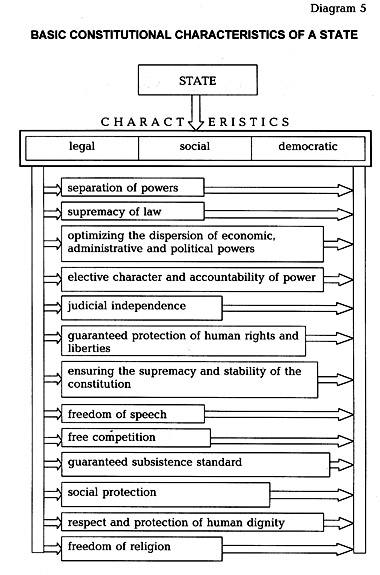
The legal, social, democratic characteristics of the state (See: Diagram 5), beside expressing certain qualitative features, properties, public relations, produce also new quality in their integrity. It assumes that typical for this state is the following:
The US experience is of great interest. Following the adoption of the Constitution, major issues remained: those of the Federal Government and the legality of slavery in that country.
The key to the resolution of all problems was however sought not in the letter as so much in the logic of the Constitution. That approach became visible in the years 1865 - 1933, when the relationship between government and economics came to be the main focus of attention. The said fundamental issue also emerged in the countries of Western Europe in the postwar period110.
In the transitional period, the old-time dispute of whether the letter of the spirit of the Constitution is to be followed seems to arrive at a simpler solution.
The acceptable option is the one in which the evaluation, the radical reforms of public relations is aimed at the fact that the adopted legal regulations or actions of the bodies of authority are generated by the fundamental principles determining the constitutional character of the new relationships thus facilitating the substantiation of a democratic, State of Social Welfare, state governed by the Rule of Law. To be also reflected in that mirror are the decisions of the Constitutional Court, they all have to be oriented so that the society would not turn away from the way of development defined by the Constitution.
This problem has also deep philosophical and legal roots directly touching upon the theory of natural and positive law. Without going deep into examining the essence of those theories, we deem it necessary to underscore that the fundamental basis of the constitutionalism should belong to the theory of natural law. The principal objective of the Constitution is to recognise the fundamental human rights and freedoms as the highest priority, to create reliable guarantees of their respect and protection.
The fact of the primacy and priority of the natural human rights has been unambiguously recognised and distinctly registered in the constitutions of many countries as the original principle. In particular:
The Constitution of Georgia, Article 7:
The state recognises and defends generally recognised rights and freedoms of the individual as everlasting and the most high values. The people and the state are bound by these rights and freedoms as well as by current legislation for the exercise of state power.
The Constitution of Russia, Article 2:
Man, his rights and freedoms shall be the supreme value. it shall be a duty of the state to recognise, respect and protect civil and human rights and liberties.
The Constitution of Moldova, Article 1, part 3:
The Republic of Moldova is a democratic, law-governed state where the dignity of a citizen, his liberties and rights, the free development of a human being, the justice and the political pluralism represent the supreme values and are guaranteed to everybody.
The Constitution of Slovakia, Articles 11 and 12 - part 1, Article 11 [Human Rights]:
International treaties on human rights and basic liberties that were ratified by the Slovak Republic and promulgated in a manner determined by law take precedence over its own laws, provided that they secure a greater extent of constitutional rights and liberties.
Article 12 [Equality]
(1) People are free and equal in dignity and their rights. Basic rights and liberties are inviolable, inalienable, secured by law, and unchallengeable.
The Constitution of Ukraine, Article 8, part 1:
The principle of rule of law is recognised and is effective in Ukraine.
Examples of this kind can be continued. However, the main issue is that the foundation of constitutional principles should be based upon a methodologically correct approach. Therefore, this approach has to be placed at the basis when examining the constitutionality of a legal act in the practice of the constitutional review. A law (or its provisions) cannot be constitutional if it tramples the human rights and freedoms. A law cannot be constitutional if it is used to trample the fundamental human rights, to establish the regulations enforcing the submission to a dictatorial authority. This, incidentally, is also a problem of ideology.
Pursuant to one of the cornerstone statements of the communist society, the public interests were placed above the personal interests. Inviability of this type of ideology was proved by life. This approach is the first step to a dictatorial rule, independent of whether this rule is imposed by a personality or by a party. Unfortunately, in the legal literature, the apologists of the positivistic theory continue to counter the simple truth of the primacy and priority of the natural human rights and freedoms. We think that in evaluating the constitutionality of a legal (positive) act, the Constitutional Court has to be guided by the constitutional principle of the supremacy of law, thus facilitating the implementation of a correct legislative policy.
With regard of the constitutional review being closely associated with social life, it is essential that in its implementation consideration should also be afforded to the particular features of the system of values of a particular society. This condition in turn will necessitate a comparative analysis of the principal constitutional concepts with regard to combining the national features with the general humanitarian values. To achieve this goal with regard to the contemporary capabilities of
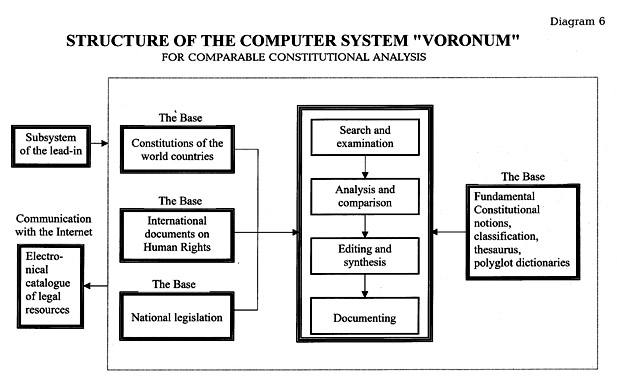
information and technology, we have developed and proposed an efficient and practically tested system <VORONUM>. The basic nature of this system is that a comparative analysis of using the basic constitutional concepts in different countries helps to uncover the general principles and regularities as well as the essential differences prompted by the systems of values in a particular country. This technique will allow not only to realise the cognitive and informational objectives, but, what is even more important, to achieve an analytical purpose, to uncover the origins, the logic of formation and functioning of the system of constitutional review throughout the world111.
A functional diagram of this system can be presented in this way (Diagram 6).
It is indisputable that the constitutional review has a huge effect upon social experience and is becoming a valid instrument of providing a sustainable and dynamic development of the social system. Besides, the social experience, in turn, can substantially determine the character and degree of a full-fledged manifestation of the functional system of constitutional review. A question arises: what is the possible functioning efficiency of the mechanism of constitutional review in a malformed society within a transitional period?
b)
Features of Constitutional Review in a Transitional Period Constitutional
Justice and Practice:
The
Character of Social Relations and the Constitutional Review
For the implementation of constitutionality, proper social circumstances and political and legal guarantees (remedies) must be provided112.
The particular social conditions that are important for the implementation of constitutionality and are essential for a democratic political systems are as follows:
- social stability. This involves material stability for the protection of a particular constitutional system against eventual sudden changes which could be caused by social powers that do not favor the present political system. From the point of view of formal legal stability, the Constitution should be the factor which stabilises the political system and its institutions. However, the socio-political system is not dependent only on the strength of the Constitution, but also on the socio-political basis of the Constitution. The socio-political basis is the cause and consequence of the strength of the Constitution. Generally we can speak about the social (material and formal) stability when the social and political sphere does not change too often and there are not any too big and sudden changes. Both elements of social stability, i.e. material and formal stability, are close to each other and both influence the implementation of constitutionality. However, social instability requires a more active role of organised subjective powers with the implementation of constitutionality for social stability.
- social homogeneity or heterogeneity. This involves the social group composition of society. If the society is more homogeneous concerning social position and social consciousness, there are advantages for implementing constitutionality and legality. The social structure of the society is the basis for determining the framework of the political system as well as the contents of the constitutionality. Social homogeneity and social peace are interwoven. All current societies are more or less heterogeneous (differentiated, structured). Therefore, their social structure influences the implementation of constitutionality.
- social consciousness and public opinion. Consideration of constitutionality and legality is dependent on social consciousness and public opinion and involves the understanding that the constitution and statutes must be considered. Such a democratic consciousness is dependent on the duration of the tradition and existence of democratic institutions. Within a concrete society, the belief must be stabilised that consideration of constitutionality and legality is a benefit and the goal of everyone. A developed social consciousness is one of the most important elements needed for the integration of a certain political system. A real democratic system also assures the creation of public opinion and guarantees its affirmation. Such public opinion may support the implementation of constitutionality and legality. Public opinion is also an important political factor for the limitation of power, and entails the condemnation of the violation of constitutionality and legality. Public opinion as a form of social consciousness became a very important political power within the social system and in such a way also a factor for the consideration of constitutionality and legality.
Constitutionality may be exercised within a certain political system only by the wilful endeavour of those social powers who have adopted the Constitution. Social stability as well as social heterogeneity influence the implementation of constitutionality. The creation of material conditions is an imperative of a stable social and political system, which in turn affects the contents and stability of political institutions.
The protection of the basic political relations determined by the Constitution is guaranteed by the different guarantees or remedies (political and legal) for the protection of constitutionality and legality of a democratic political system. Constitutionality and legality can be exercised only within appropriate social circumstances. There are socio-political and legal remedies that guarantee the implementation of constitutionality and legality.
Socio-political guarantees include institutions and instruments that implement constitutionality and legality which are at least partially dependent on human will. The most important remedies are the following: democracy, the separation of powers, and reducing State power and State bureaucracy. The appropriate organisation of power (the separation of powers) is one of the most important remedies. Socio-political guarantees ensure the objective circumstances necessary for the functioning of the political system that assure that constitutionality and legality function more efficiently. Within a State governed by the rule of law, socio-political remedies only consist of guarantees of the efficient functioning of the political system (the prevention of a concentration of power).
In a contemporary State governed by the rule of law, the first legal remedies are the judiciary and constitutional justice. The judiciary as a legal form of the protection of constitutionality and legality was developed through many steps: civil, criminal, and administrative judiciary. The judicial protection of constitutionality, i.e. the constitutional review (exercised by constitutional justice), however, was introduced following the realisation that regulations of State bodies can also violate the Constitution, and was established with the introduction of written Constitutions, and is the highest form of the legal protection of constitutionality.
The concentration of power can be limited only by the separation of powers into legislative, executive and judicial branches. The principle of the separation of powers is an essential component of constitutionality. It is a basic principle of democracy. The result of the introduction of the judicial review of constitutionality was a qualitative change as regards the principle of the separation of powers. Where it was introduced it has become increasingly important in the political field, and it has become an increasingly essential component of the mechanism of State authority as its decisions actively intervene in political and social life.
The political guarantee for the implementation of constitutionality is the right of individuals to participate in public affairs. This requires debureaucratisation. The institutionalised guarantee against the bureaucracy of political functions is a multiparty system and general and equal souffrage, which assure the relatively quick change of political structures.
Constitutional review is also a remedy against anomalies concerning the concentration of powers within executive bodies. In particular, an excess of State legislative activities oppresses individuals within the political system. Constitutional review is a remedy for balancing processes which could lead to State intervention into certain fields of human activity.
The legal guarantees and/or legal remedies for the protection of constitutionality and legality are as follows:
The principle of the rule of law (the principle of legality) means that all State bodies must act on the basis of the Constitution and statutes. A self-interest imposed on the principle of expedience is, as a rule, excluded. The principle of the rule of law or the principle of legality is closely bound with the legislative function of a contemporary State. Because a statute is the most direct reflection of sovereignty, the activity of the administration and the judiciary must be subordinated to a statute; within this scope, the principle of legality and the rule of law are reflected. The principle of legality is bound with the idea of basic rights as well as with the separation of powers. In addition, the mentioned principle also has a certain other meaning: the request for the conformity of lower regulations with higher regulations. The principle of legality also reflects the desire to limit power and its political liability (the principle of the political liability of authority). Authority is limited, in particular, by legal norms. This principle of legality regulates the relationship of the executive-administrative and judicial power by statute. The principle of constitutionality means that all other general legal acts must be in accordance with the Constitution, because the Constitution has the position of the supreme act. Constitutionality has a formal (the process for adopting an act must be in conformity with the Constitution) and a material character (the contents of all other general legal acts must be in conformity with the Constitution). The principle of legality reflects the formal and material conformity of executive or individual acts of the administrative and judicial bodies with statutes.
At all times in human history the changes of social system were compared with earthquakes, since more often than not a qualitatively novel situation emerges characterised with indeterminacy, uncontrollability, disbandment of institutional systems, confusion of thought, unpredictability of processes, indistinct actions and social tension. This is essentially an all-embracing social stress, with an initial period of a typical shock situation transgressing into a situation of alarm and indeterminacy, which are overcome to start a period of stabilisation and development.
Appearing in this situation were nearly all post-communist countries. That was particularly visible in the republics of the former Soviet Union. The matter is that they had lived through a double collapse: that of the system of public relations and the state structures. If the former assumed a transition of the economy to the market relations and embedding the public relations characteristic for a democratic state governed by the Rule of Law, in some New Independent States also a State of Social Welfare, based on the principle of separation of powers, the latter rather prompted urgent action to form an autonomous state system, i.e., to make a whole out of a part.
The implementation of the objectives thus noted demanded primarily an actuation of the whole range of instruments for crisis management, to achieve a reviewable transition, to mitigate the inevitable negative aftermath of the system transformation, to overcome the political, economical, psychological indeterminacy, as well as the indeterminacy of the entire system of values, to distinctly earmark the new rules of social life, to establish new structures replacing the ones demolished and to resolve a multitude of other problems without delay. It was needed to apply enormous efforts to preserve the rhythm of life, to get new bearing in time and space.
With regard to the public administration and to the subject under study in particular, answers to the following questions are of crucial significance, particularly for the countries of the former USSR:
The political evaluation of the emerging situation by the West was as follows: they had interacted with the "Evil Empire" and an irrational economic system, and so, the efforts by Gorbachev at its transformation were qualified by them as heroic.
However, the Gorbachev reforms at the very beginning were doomed to failure for a variety of reasons. Firstly, they mainly encompassed the sphere of economy with almost no concern to the political system. Secondly, the societal processes became unreviewable, overstepping the boundaries of the sought and imposed decisions. Moreover, not only they could not make room for the new reality, but rather assumed the role of the detonator for the in-depth social transformations. The best example is the New-Ogarev process, the referendum of March 17, 1991, the short-sighted reaction of the Union's center to the processes taking place in the Baltic States, Armenia and other regions. Thirdly, there was an erroneous perception and evaluation of the international factor. On one hand, there was an underestimation of the geopolitical interests of the West, a possible effect of the external factors, on the other hand, there was a prevalence of dizziness and an unsubstantiated inspiration.
To be also added is the unavailability of a distinct idea on what was to be done, as well as a distorted perception of the actual environment, the picture will be complete.
All that shows that the "maturation" of the actual environment took place with no regard to the will of the rulers and within a "hidden period".
Quite naturally, the reforms had to be of explosive character, with all relevant consequences. Actually, the historical reality is such that the system collapsed with the subject nations unprepared. Moreover, all efforts by the Moscow authorities and the international circles were intended to confuse the public opinion, as well as to create distorted ideas of the events to come. Naturally, in this type of situation there were inevitable psychological stresses and distorted outlook that enhanced enormously the difficulties of the transitional period.
Coming to the foreground in a similar situation are the approaches to crisis management to resolve at least two objectives. First: to prevent chaos and to exit this situation with minimal losses using an organised and reviewed means. Second: within the shortest time possible to identify the priorities, to prepare the state machine to work in the mode of functional administration, to establish a legal field pursuant to the new social relations and an institutional system of administration. The resolution of those problems for the European (former communist) countries had a peculiarity that on one hand they had a clear idea of the future, their social consciousness, mind had still retained the values to be reinstated, with their carriers being in the majority. On the other hand, there was an integral national-state system that had a relatively autonomous economic structure with a certain structure that created vast opportunity for integrating with the advanced European systems of values, as well as a most favorable geopolitical situation.
For the Republics of the former USSR significant was not only the factor of inertia, the problems silenced for years, and therefore manifested with special acuteness, but also the situation that the autonomous action was far more complicated. That was on one part explained by the fact that the economic links and their interaction were relatively independent compared to the political processes, and still under inertia. On the other hand, the conflicts of interests were manifested because of uncleanly formulated prospects, new solutions and the ways of their achievement. It was an enactment of the old slogan "save yourselves as you can". It was not by accident that after the formation of the Commonwealth of Independent States the jointly adopted resolutions mostly remained as good intentions, and remained unaccomplished.
All that is largely stipulated by the fact that for most of the New Independent States it had been for a long time unclear, what the direction of transition is and what in-depth transformations are needed for that (the best testimony to that is the referendum carried out in March 17,1991, in nine republics of USSR).
The transitional period may be provisionally divided into the following periods of time.
1. The period prior to the transition to new social life. Theoretically that can be a reference to the entire 70 years (for many of those years were the years of exile, political persecution and hopeless struggle). In actual life it was motivated by half-measures of economic reforms, and following the unsuccessful trials of 1953, 1965, 1979 and 1985 received an all-embracing public character after 1987, when the Perestroika got into an obvious default. That period can be classified as a hidden period of a ripening collapse, since, as noted, implementation of a transitional program was replaced by belated efforts to impede with social reforms and to mislead the society. It can also be considered the period of lost opportunity, since almost no preliminary work has been done to keep it going within the new reality.
2. The period of the actual collapse of the USSR and the subsequent shock. This period embracing 1991 - 92 is characterised as follows:
It is to be added, that the independence, having received the political, moral, and psychological recognition, had become a fait accompli and demanded an economic and social compensation.
It was at that time that a decision was pending for two crucial problems: first, to overcome the anxiety of the transitional period; second, to clarify the basic positions with relation to the process of a further development of society and their legislative adjustment.
3. For many New Independent States the subsequent years, until the adoption of the new Constitution became the years of discrete transformations and some stabilisation. There was a considerable consolidation of the legislative basis with regard to the new public relations, mainly arranged was the establishment of the institutes of state administration, the independent economy acquired new features, particularly by introducing the national currency and the financial-banking relations, establishment was made of the operational international connections that also adjusted the character of economic reforms. Meanwhile, the search for certain solutions had to be accompanied by the correction of mistakes.
That phase enclosed inherent pitfalls and dangers.
Most perilous for the society were not so much the chronic ulcers as the newly emerging phenomena that stepped into the phase of irrational reproduction. One of the significant derelictions in the state administration (incidentally this was typical for many republics of the former USSR) was that there was no deployment of a planned and efficient effort to overcome the negative processes and to ensure an anticipatory character of the positive results of the reforms being undertaken. Moreover, within a short period of time the social polarisation attained a level that the society was not yet ready to accept. In turn, many of those who initially entered the race moved by the ideals, ceded to the temptation of corrupt practices, thus devaluating both themselves and the ideals in the eyes of society.
No due attention was paid at this phase to reforming of the judiciary and legal system, to establishing an operational and efficient system of constitutional review in particular.
4. There followed the post-constitutional period of significant distinctions when the New Independent States embarked on systemic reforms. This period will last until the legal and democratic relations gather a sufficient critical mass to become the principal catalysts of social life, until the market relations embrace all productive processes.
The difficulty thereof is, however, in the need to prevent the negative phenomena and to spur the positive shifts so that the negative trends would not prevail or block further development. As to the rapid positive changes, they can be expected only in case of complex, mutually coordinated active steps with care taken to secure the immune system of society.
International experience shows that justifiable in such situations is the formation of a relatively active system of constitutional review, rather than a wait-and-see approach. There is an opinion in the literature that the emergence of specialised institutes of constitutional review in Germany, France and in a number of other European countries was conditioned by resolving specific problems prompted by systemic reforms113. We think that the constitutional review is rather characteristic to a society embarking on a path of dynamic and stable development, where democracy was transformed from a slogan into the vital need and the substance of activity, primarily for the state authorities. In the meantime, the constitutional review is a powerful means to change the society in this way. Naturally, the transitional period in certain countries (e.g. in Armenia) is manifested in some peculiar way: a fairly restricted set of objects and subjects of review is established which appeal to the body of constitutional review, with insufficient focus afforded to the issues of official interpretation of the Constitution or to resolving the litigations in respect of jurisdictional disputes and to efficient use of implements for ex post facto abstract review that in the transitional period capable to largely facilitate the overcoming of internal controversies of the legislative system and to ensure the supremacy of the Constitution.
It is to be noted that in the transitional period the cornerstone is the formation of an acting system of constitutional review, so that the principal condition of its implementation is the establishment of a specialised Constitutional Court endowed with sufficient powers and possessing the preconditions necessary for the activities. The best example of the aforementioned are certain countries of Eastern Europe.
Beside a stronger position of the Slovenian Constitutional Court within the scope of national system and beside deciding upon constitutional complaints regarding violations of human rights, the most important novelty in comparison with other respective systems of the New Democracies is a conspicuous cessation function of the Slovenian Constitutional Court with reference to the statute. This means that under Constitution 1991 the Constitutional Court may abrogate a statute. In some other systems of the New Democracies such a concentration of power in one and only institution (the Constitutional Court) could be even limited with the power of review of statutes the Parliament.
The Slovenian Constitutional Court acquired the status of a independent institution for providing constitutional review in relation to the Legislature characterised by the explicit power to abrogate the statute adopted by the Legislature. The former function of the Constitutional Court, (due to the Principle of Unity of Powers and Supremacy of the Parliament) focused on assessment of unconstitutionality of a statute, changed into an active relationship not only involving the cessation of the statute, but also the guidance of the Legislature in its legislative activity. However, the concession by the Constitutional Court to the Legislature is still possible, which means that the Court does not abrogate the disputable statutory provision, but rather enables the Legislature to reconcile the disputable statutory regulation with the Constitution within a due period of time, pursuant to the guidelines of the Constitutional Court in a specific decision (see Article 48 of the Constitutional Court Act).
In this period the Constitutional Court played a more important role based on its new extended powers. In the sense of contemporary trends, the Slovenian Constitutional Court, too, has assumed the role of a negative Legislature114. In the period of transition the Legislature is not always able to follow the development nor to impose standards for all shades of the legal system and its institutes. This results in the so-called interpretative decisions taken by the Court or the appellative decisions115 or certain declaratory decisions that include certain instructions by the Constitutional Court to the Legislature on how to settle a certain question, or a specific issue (Article 48 of the Constitutional Court Act). However, in compliance with the Principle of Judicial self-restraint, a clear limit has been imposed on the Slovenian Constitutional Court due to the fact that the Court has actively been creating the legal rule both negatively (e.g. the abrogation) and positively (e.g. the appellative, interpretative, the declarative decisions), a function theoretically reserved for the Legislature. On the other hand, there arises the question whether the Constitutional Court, in deciding on the existence or non-existence of a specific provision, actually creates the law, because it carries out a review of legislative activity. In any case, the Legislature cannot avoid the existence of constitutional case-law in its activity.
At the same time the Slovenian Constitutional Case-Law, arising from a certain tradition, could serve as an example of presentation of knowledge and techniques of a national legislative practice. On the other hand, the comparison of certain topical views could as well add to the promotion of a national democratic process and culture. Accordingly, it could have direct applicative value in the search for the systemic solutions in some other countries.
In the transitional period, the central issues of constitutional review, as noted, is the competence to interpret the Constitution, as well as to overrule the legislative contradictions.
The right to the abstract interpretation of the Constitution belongs to the Constitutional Courts of 29 countries, including Russia, Azerbaijan, Bulgary, Kirgizstan, Moldova, Slovakia, Uzbekistan et al. However, the competence to abstract interpretation of the Constitution can engage the Constitutional Court into a political process and weaken its mitigating role. It is also essential, particularly in the transitional period that the litigations in respect of jurisdictional disputes of the bodies of authority be resolved in a legal way, at least by interpreting the Constitution, rather than would go into a stalemate or be decided in a confrontation. In this regard one of the best solution is the competence of the Federal Constitutional Court of Germany stated in Art. 93, clause 1 of the Basic Law:
"(1) the Federal Constitutional Court will resolve cases:
1) on interpretation of the present Basic Law in the event of disputes concerning the extent of the rights and duties of the supreme federal organ or other parties concerned who have been endowed with independent rights by the present Basic Law or by Rules of Procedure of the Supreme Federal organ."
As to the laws adopted prior to the Constitution, certain rules are established in their regard, so that they remain valid to such a measure that they do not contradict the new Constitution. Is this formulation sufficient? Clearly not. The matter is that it is necessary to identify the fact of contradiction and to ensure the harmonic condition of the legislative field. The constitutional courts of certain countries simply do not accept for hearing a case on the constitutionality of this type of laws. Particularly hard is the situation in the countries where such laws fall under the jurisdiction of the Constitutional Court, however the subjects of appeal do not exercise their right to appeal, while the legislative body has no distinct position on this issue. A typical example is Armenia. The analysis carried out by the staff of the Constitutional Court of Armenia has shown that 2/3 of the examined laws contain provisions contradicting the Constitution. These materials were dispatched to the President, the Government (as the Subject of a Legislative Initiative) and the National Assembly. During a year there was no shift, and those regulations are still acting.
We think that an interesting solution of this problem is found in the Constitution of Romania (ss. 79 and 150), providing an institutional system resolving the problem as a complex within the time set by the Basic Law.
Another feature of the transitional period is the lack of guarantee for independence and stability of the constitutional review. That is testified by the experience of Russia, Belarus, Albania, Tajikistan. Any interference into the activity of constitutional review contains a boomerang effect and can trigger extremely irrational processes. Therefore, the major objective is ensuring the independence of the judicial constitutional system and establishment of the necessary, sufficiently functional, institutional, organisational, logistical and social guarantees of its operation.
Moreover, it is essential to establish an efficient mechanism of resolving the disputes between the Constitution and politics. In countries of developed democracy this objective is resolved by public consensus, with no political shocks. Meanwhile, frequently, in collisions between the new political realities and the Constitution, the latter is sacrificed116. As to the post-communist countries, resolving this type of controversies often results in constitutional coup.
To avoid this type of situations, the constitutional courts should contribute maximum effort to lend the constitutional and legal character to the political division.
There is also a problematic issue emerging when the constitutional changes lag behind the real life and the logical development of social process. In this kind of situations, irrationality appears even in the constitutional courts' decisions. As emphasized by Andrash Shayo, the social and political aftermath of the Hungarian Constitutional Court decisions taken in 1995 (on the socio-economic rights) show that the supremacy of law and the constitutional procedures played an obstructionist role, preventing the reformation of the inherited social system117.
We think that the outcome of this type of situation should be sought in improving the Constitution itself and by overcoming the intra-constitutional controversies, rather than in limiting the functions of the body of constitutional review.
| Previous |