In the institutional dimension the specific steps in this field have been made within the past 30 - 40 years. However, what has been done is far behind what is required for the sustainable human development and establishment of an efficient system of state administration or the implementation of guaranteed systemic constitutional review within the new millennium. At the same time individual constitutional courts increasingly share more common elements regarding organisation, proceedings, and rationales for their decisions and opinions. An important stimulus is provided also by the integrational tendencies in constitutional justice.
An example of such a semi-official conduit is the European Conference of Constitutibnal Courts established in 1972 in Dubrovnik in the former Yugoslav Federation, which includes almost 40 European and non-European countries86. This is possible due to the already existing similar functional principles, common to all constitutional systems. The Conference exists as a forum for the international exchange of opinions in the field of constitutional review. These are meetings of "pure" Constitutional Courts and other corresponding institutions of constitutional review. The work of constitutional courts are, in many respects, of far-reaching importance. They contribute to the strengthening and better articulation of constitutional case-law.
The chronicle of Conferences to date:
The initiators of the first meeting of the Conference of Constitutional Courts in Dubrovnik were the Federal Constitutional Court of the former Yugoslav Federation and the Constitutional Courts of Italy and the Federal Republic of Germany. Subsequently the Constitutional Court of Austria, the French Constitutional Council and the Swiss Federal Supreme Court also joined. It was decided that the courts would meet every three years, and that a particular preliminary preparatory meeting of presidents and secretaries would be held in the country of the particular court which was next due to host the Conference.
The participants of the first Conference underlined first of all the general importance of professional meetings for the development of international cooperation between the Constitutional Courts, as well as for a better understanding and protection of constitutionality and legality irrespective of all the differences between various social, economic and political systems. The Conference is the sole international forum where basic questions on constitutional review can be discussed on a comprehensive comparative basis.
The first contact committee of the Conference was composed of the Constitutional Courts of Austria, Germany, Italy and Yugoslavia. The international cooperation resulted from an initiative by the Federal Constitutional Court of Yugoslavia. Following this initiative, the first Conference was held from 17 to 20 October, 1972, in Dubrovnik. The Conference discussed the powers of the Constitutional Courts as well as the effects of their decisions. The first Conference was attended by the following Constitutional Courts and other institutions exercising constitutional review: Austria, France, Germany, Italy, Romania, Switzerland and Yugoslavia.
This group (or association) of Constitutional Courts is not an institutionalised body; it works if necessary on the request of one of its members. Its competencies are the preparatory activities for the conference, and the determination of conference topics. This lax association is mainly guided by the mentioned Constitutional Courts as well as by the Swiss Federal Court, which also has a long tradition. Subsequently, some other courts joined this leading group, e.g. the Constitutional Courts of Spain and Portugal, as well as the French Constitutional Council.
The Conference is an instrument which has promoted the usefulness of constitutional review, including the constitutional protection of human rights and freedoms. The Conference has supported the introduction of the constitutional review in particular countries where such an institution had not been known before. In addition, the Conference has contributed to the strengthening of the status of the Constitutional Court within the national legal system of every country hosting the Conference.
The location and topic of the next Conference are decided during the previous Conference. The official language of the Conference is the language of the country (of the Constitutional Court) hosting the Conference. Reports on the Conference have been predominantly published in the European Human Rights Magazine. The Conference has not adopted its own permanent rules of procedure; every Conference has adopted new rules of procedure, but the respective text has remained unchanged.
The activities of the Conference are closed to the public. However, the public is informed of the ceremonial opening and of the final official report of the Conference. No formal conclusions of the Conference concerning proposed and/or discussed topics or questions have been reached, but in any case a final official report has to be accepted and published. The body which initiates and reaches decisions in practice is a select group of presidents and secretaries general of various Constitutional Courts. The President of each Conference is the President of the Constitutional Court hosting the Conference. In principle, the decisions of the Conference are issued by consensus.
The organisational costs of the Conference are divided between the members. Each delegation covers its own travel and accommodation expenses. The Constitutional Court organising the conference covers the main part of the organisational costs.
The number of delegation members is limited to 4 judges and a secretary, however, this number is often exceeded. Participation in the Conferences was mainly limited to European countries, along with some observers, or associated members from other parts of the world. Furthermore, the Conference has not been attended by the Constitutional Courts of the member states of federal countries.
The Conferences are meetings of "pure" Constitutional Courts and other state institutions exercising constitutional review. The Conference participants are the Constitutional Courts which have already been organisers of Conferences, as well as Constitutional Courts which have been accepted as members of the Conference on the basis of written requests and submitted reports concerning the activities of their Courts. The Conference does not have a permanent Secretary, it works only as a select group and in plenary sessions (the assembly of the officially participating Constitutional Courts).
The main problem is that the Conference has no explicit standing orders or system of its operation. The mechanisms of cooperation within the framework of this Conference need a further improvement and itemisation. However, the first Conference Standing Orders were adopted by the Warsaw Conference (from 16 May to 20 May, 1999),
The Commission for Democracy through Law (the Venice Commission) of the Council of Europe, established in 1990, includes almost 50 European and non-European countries; The Commission homepage87 includes many links to Internet sites with information on constitutional courts or equivalent bodies of member states, associate members and Commission observers88.
The first attempts to establish the Venice Commission were made at the European Conference of Constitutional Courts, which was held in 1987 in Lisbon. The greatest supporters of this idea were the presidents of the Constitutional Courts of Italy and Germany. The Commission was formally established at the Conference of European Foreign Ministers of January 1990 in Venice. Therefore, the Commission was called the Venice Commission. In May of 1990 the Charter of the Commission was adopted on the basis of a special agreement, and closed with the Council of Europe. The member states of the Council of Europe are not members of the Venice Commission automatically. It is necessary to apply for membership on the basis of an appropriate document.
The first session of the Commission was in 1991 in Italy. The Venice Commission also has some subcommissions, which have been dealing with theoretical and practical problems related to the constitutional systems in the member states. The Commission includes 37 full members, five associated members and eight observers. The members of the Commission are mainly European countries, however also some non-European countries are represented89.
The main task of the Commission is to promote the principle of the Separation of Powers, the principle of the Rule of Law and a State of Social Welfare, support the development of the judicial review of constitutionality as well as to promote the development of the information bases of bodies exercising constitutional review in member states. Beside the countries with constitutional review systems with a long tradition, there are member states where this institution is still in the process of being adopted and developed.
The aim of the activities of the Venice Commission is to implement the principles of the European legal heritage in national constitutional and legal systems. The seat of the Commission is in Strasbourg, the permanent meeting place is in Venice. The members of the Commission are mainly lawyers and experts in constitutional law. An important form of the Commission's activities are specialised seminars, the so-called UniDem seminars, where global problems are discussed which concern all constitutional systems, e.g. human rights protection, referenda, the federal structure of states, constitutional review, etc.
The results of the Commission's activities are as follows:
One of the latest UniDem seminars was organized with the cooperation of the Constitutional Court of the Republic of Armenia, October 14 - 15, 1998 on the subject: "Constitutional development: separation of powers".
The tree-year-old cooperation of the Constitutional Court of Armenia with the Venice Commission shows that this organisation plays a very considerable role in the development of constitutionalism, attestation of reliable guarantees for the protection of human rights and freedoms, establishment of a true local self-government, formation of legally operational institutes of judicial constitutional review. The Venice commission also plays an active role in data support and exchange of experience among the Constitutional Courts.
The CIS Conference of New Democracies was founded in October 1997 in Yerevan, Armenia90. The first meeting of the newly established Conference was held in Minsk in June 1998.
The Conference of the Bodies of Constitutional Review of the Countries of Emerging Democracy is an aggregate advisory body, established and acting based on principles of voluntary participation, equal rights and openness. The purpose of the Conference is to promote the consolidation of democratic processes in the New Independent States by activating the consulting cooperation of the Constitutional Courts, systematic study and generalization of the experience of the New Independent States in the domain of constitutional review and oversight, uncovering the basic features stipulated by the transitional period, organising the topical discussions on the issues of common interest, defining the tendencies of development of the operational systems of constitutional review and review.
The Conference exercises its activity guided by the generally accepted principles and standards of international law, the respect of legisiations of the countries whose Constitutional Courts are participants of the Conference.
The conference work is organised in the form of a session (by plenary sessions), which is the highest authority of the Conference. The Conference can generate committees as applied to the issues on the agenda.
The sessions of the Conference are open.
In its work the Conference can accommodate the representatives of international, intergovernmental and non-governmental organisations, representatives of Constitutional Courts of states not participating in the Conference, as observers or invited participants, by the resolution of the Conference. The Constitutional Court convening a regular session of the Conference, can extend invitations to representatives of other organisations or the media.
The official languages of the Conference are Russian, English, and French, the working languages are Russian, English and the state language of the home country of the Constitutional Court hosting the Conference.
All that shows that the Regulations of the Conference actually provides all the necessary conditions for the open-minded, interested, business-like and constructive cooperation.
Also not devoid of certain interest are the organisational forms of the Conference's activities. The Coordinator of the Conference is the Chairing Constitutional Court, while at inter-sessional periods coordination is done by the Constitutional Court that had hosted the latest session of the Conference. The Conference's auxiliary bodies are the Secretariat and the Editorial Council.
At inter-sessional periods the Constitutional Courts taking part in the Conference can introduce changes in the draft agenda of a regular session of the Conference, applications to that effect should be submitted to the Constitutional Court coordinating the Conference with at least 3 months’ notice.
The Documents of the Conference are adopted by open voting.
At the request of any delegation of the Constitutional Courts participating in the Conference, the voting can be a roll call voting with a subsequent recording in the protocol.
The Conference in the process of its activities can adopt acts, to be legally classified as follows:
Resolutions, closing acts, communique are to be signed by all heads of delegations.
The Conference is a publisher of a special Bulletin "The Constitutional Review", the editorial board of the Bulletin has been established.
The working experience within the last two years shows this type of cooperation to have a big potential for further development, mainly in the following directions:
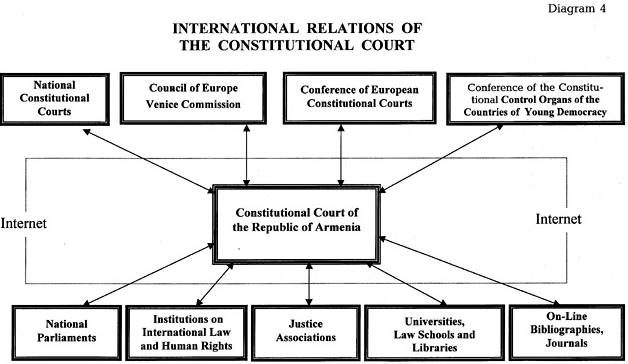
The Constitutional Court of Armenia attaches great significance to activating the international links on a systematic basis. The substance of the latter consists just in insuring the continuance of data flows, a complete coverage of the system, operational efficiency in providing assistance to the members of the Constitutional Court when preparing and examining individual cases, studying the common approaches and specific features of the manifestation of the constitutional review in different countries, as well as providing the active participation of the Constitutional Court of Armenia in discussing the current issues of constitutional review. This objective is schematically resolved in the following way (see Diagram 4).
The operation of this system is realised only when actively using the contemporary technical capabilities.
The experience of the bodies of constitutional review of the countries of emerging democracy graphically shows that the consolidation of international cooperation becomes an erogenous factor in comprehending the role and insuring the independence of the Constitutional Courts. Moreover, the real cooperation is becoming a crucial factor in consolidating the international stability and the sustainable human development.
The South American Group of Constitutional Courts was founded in 1992 in San Jose, Costa Rica, where the first conference of this group of countries was held, and includes 10 countries. The first conference of this group of countries was also held there. In addition, a Group of Spanish Speaking Constitutional Courts was established (the lbero-American Conference of Constitutional Review), composed of such countries as Costa Rica, Guatemala, Paraguay, Venezuela, Mexico, Nicaragua, Peru, Brazil, Spain, Portugal. The first conference of this Group was held in Lisbon (constitutional review in general), the second in Madrid (the individual complaint before the Constitutional Court), but the third one in Guatemala City in 2000.
The Arab Group of Constitutional Courts and Constitutional Councils was founded on 25 and 26 February 1997 in Cairo, Egypt, where the first conference of this group of countries was held, and comprises 11 countries91. The first conference adopted the Charter of the Group regulating its organisation and activities.
In addition, the West African Association of the Supreme Courts using the French Language (A.O.A.-H.J.F.) was established on 10 November, 1998 in Cotonou (Benin). The Association supports cooperation between institutions that promote the development of the role of the judiciary concerning the consolidation of democracy and the principle of the Rule of Law.
The Association
of Constitutional Courts using the French Language - A.C.C.P.U.F., established
in 1997 in Paris, includes 49 European and non-European countries92.
The first conference
of this Association was held in Paris in 1997, the second in Beirut in
September 1998.
Other more recent features tending to integrate information systems are (1) the information system of European and some non-European constitutional/judicial review bodies, managed by the Venice Commission of the Council of Europe since 1991, and (2) the recently developed lnternet connection of the constitutional courts. Furthermore, the mentioned associations, particularly the A.C.C.P.U.F., are also more or less supported by a computerised documentation service or a respective center.
The International Association of Constitutional Law (IACL). The objectives of the Association are: development and elaboration of the constitutionalist network, creation of a knowledge base and data for development and comprehension of constitutional systems; examination and comparison of common constitutional principles and problems; offering consultations and advice that could be helpful in resolving specific issues.
Why was it that Europe did not adopt the American model? Many attempts have been undertaken to provide an answer to this question93. In one case the answer was sought within the dimension of the differentiated perception of the concepts of "Law" and "Constitution". In another, the emphasis was made upon the peculiarities of the judicial system and activity of judges (with a particular focus upon the degree of court independence and the ability of the judges to provide a solution on constitutionality of law). In the third case the emphasis was on the type of objectives set by the society of a particular country and on the peculiar features of their resolution.
Anyway, for more than a century the function of constitutional review has been carried out by the ordinary courts throughout the world. However, the stormy changes of social life in early 20th century under the conditions of separation of powers confronted the specialists with a number of problems:
The European system contains three basic priorital objectives:
a) providing the constitutionality
of regulatory acts so as to retain the constitutionally stated functional
equilibrium of the autonomous branches of power;
b) a distinct regulation
of resolving the disputable issues emerging between different bodies of
authority in respect of powers;
c) creation of a most
integral and reliable system for protection of the constitutional human
rights.
Another question is in what way those problems found their solutions early this century. To our mind, in actual reality, the implementation of constitutional review using the new specialised and centralised system provides a gradual stage-by-stage resolution of those issues, this trend today resting in the basis of the internal logic of the system's development.
A characteristic feature of these systems is not only in that the review is carried out by a specialized body. Particularly important is the fact that a substantial change is taking place of both the forms and character of review95.
In particular, only this system has inherent forms of preventive, abstract and mandatory review. By virtue of this approach the constitutional review acquires an integral, complex character and can be implemented in a consecutive and effective way.
This system, with the fundamental feature of the centralised review implemented by a specialised body, has at the same time important peculiarities, both structure-forming and functional. It should be noted here that those features manifest themselves in the way of recruitment of the bodies of constitutional review, in its composition and structure, in who and in what way can apply to these bodies, in what is the type of review (abstract, concrete, preliminary or ex post facts, mandatory or elective), what is the object of review, and who is the subject, what type of decisions are adopted by the bodies of constitutional review, etc. Those are the questions that we tried to respond both when examining the individual problems and the features of operation of constitutional review as performed in different countries.
| Previous |