Historical Stages in the Development of Systems of Constitutional Review and Particularities of Their Basic Models
The Development up to World War IAncient Athenian law distinguished between a nomoi (which might in a certain sense be compared to contemporary constitutional laws), and a psephisma, which in present times might be called a decree7. The fundamental principle was introduced that the decree (a psephisma), whatever its contents, could not conflict with the nomo in either form or substance. Two consequences attended the enactment of an unconstitutional psephisma. First, the member of the legislature who had proposed the illegal decree incurred criminal liability, which gave rise to a public right of action. Second, psephismata that were in conflict with the nomoi were considered void. The Athenian judges, although in principle obliged to decide cases on the basis of both the laws and the decrees, were bound by the latter only in so far as they were consistent with the former.
Certain elements of constitutional review go back as far as the year 1180, i. e. to the old German Reich. At first the corresponding judicial bodies dealt primarily with jurisdictional disputes between individual rulers and partly even with infringements of rights. Certain elements of constitutional review kept emerging under different forms throughout German legal history, until it was introduced in the present sense of the word with the Weimar Constitution. Preliminary forms of constitutional review existed in France by the middle of the 13th century. Portugal introduced its constitutional review in Philips Code in the 17th century. More serious projects of constitutional/judicial review appeared in the Constitutions of Norway, Denmark and Greece in the 19th century.
In 1867 the Austrian Federal Court acquired the jurisdiction to deal with jurisdictional disputes concerning the protection of individual political rights vis-a-vis administration; the State Court, on the other hand, made decisions on constitutional complaints (Staatliche Verfassungs-beschwerde).
Although some initial elements of constitutional review can be seen already in the Federal Constitution of Switzerland (1848), the Swiss Federal Court acquired broader powers only with the modification of the Constitution in 1874.
In Norway constitutional review originates in jurisprudence dating from 1890. Romania introduced constitutional review before World War I following the American model.
While the modern English legal system knows no constitutional review, English legal history does include some of its elements, i.e. the principle of the supremacy of the Constitution dates back to 1610 and is of essential significance for the development of constitutional review in England. Another example of an English contribution to this development is the impeachment originating in the late Middle Ages. Ideas about the supremacy of the Constitution and the right to judicial review spread from England over to the United States. There, already at the end of the 18th century, the Court proclaimed individual English Acts null and void on the territory of the North American States. However, according to the 1789 Constitution the Supreme Court as the highest Federal Court did not have any express constitutional powers. The decisive impact on the development of constitutional review was exerted by the famous Marbury v. Madison Case (1803), in which the Supreme Court arrogated the power of judicial review concerned with the conformity of statutes with the Constitution. This gave a basis for the enforcement of the power of the American Supreme Court to carry out the judicial review of statutes. Although the next similar case appeared in this Court only in 1857, the way to the constitutional review of regulatory measures had already been paved8. This enabled the power of the American Supreme Court to be applied for a judicial review of a law. This decision actually recognized as unconstitutional the part of procedural law adopted by the Congress in 1789 that referred to the powers of the Supreme Court (paragraph 13)9. Chief Justice John Marshall produced a classical formulation by asserting that "the judiciary logically and of necessity had the power to make final and binding interpretations of the law.. The Law that is incompatible with the Constitution is invalid"10.
The American Supreme Court created the grounds for the new institution in practice, i.e. the judicial protection of constitutionality. Such an American system of constitutional review was adopted primarily in some particular South American countries. Some of them explicitly determined the matter by their constitution. In Europe, except in some Scandinavian countries, such a system of (indirect) judicial review of constitutionality could not be introduced because of the too high reputation of the legislative bodies.
Exclusive from the point of view of the history of constitutionalism and particularly of historical development of constitutional review is the Constitution written by Hakob and Shahamir Shahamirians under the title of "The Trap of Vanity" in 1773-1788. This work containing 521 Articles and presented following the theory of natural law is essentially, the first Constitution harboring an idea of a particular specialized court, "the High Court", that would have a mission, in a contemporary meaning, of implementing a judicial constitutional review.
The French, on the
other hand, have clung tenaciously to the idea that no judicial body should
be given the power to review the conformity statutes with a supposed higher
law. The legislature, therefore, as the voice of popular sovereignty, was
seen as the best guarantor of fundamental rights. From the standpoint of
the development of constitutional review in continental Europe, France
has always been against the notion that the acts of superior bodies and
especially of parliamentary assemblies, as representatives of national
sovereignty might be subjected to review by the judiciary11.
The Development between the Two WarsThe development between the two Wars is referred to as "the Austrian period". The Constitution of 1920 marks the foundation of the Austrian Constitutional Court with the exclusive power to review the constitutionality of statutes (at first, however, only of a preventative nature), following the work of the Austrian legal theorists Adolf Merkl and Hans Kelsen.
Following the example of the Austrian model, before World War II constitutional review was introduced in the following countries: Czechoslovakia (1920), Liechtenstein (Staatsgerichtshof, 1925), Greece (1927), Egypt (1941), Spain (1931) and Ireland (1937). The trend to broader enforcement of constitutional review was interrupted by the War and the already founded institutions failed to become active in practice (e.g. from 1933 through 1945 Austria was without constitutional review, after 1938 Czechoslovakia was without constitutional review).
The Development after World War IIConstitutional review in the proper sense of the word, taken from the theoretical point of view, was able to develop only when instead of the principle of the sovereignty of the Parliament12 there prevailed the idea of the supremacy of the Constitution13 and where constitutional review is performed by a special body, independent of the legislative and executive power14. Such approaches were characteristic of the development after World War II. On the other hand, constitutional review also involves the principle of the vertical separation of powers. It emerged in federal states, whereby constitutional review was supposed to exert supervision over the federal Legislature in relation to member states. This was also due to historical reasons: the painful experiences of the past War and Fascism as a counterweight gave birth to the idea that constitutional review was characteristic of democracy. There were also institutional and political reasons: constitutional review should also represent efficient protection vis-a-vis legislative and executive power. The final step was to provide a means for guaranteeing government's obedience to the constitution, separate it from the legislative power itself and embody it in the active work of judges or, in some systems, of a special constitutional court15. This active work of the judiciary makes the necessarily vague terms of constitutional provisions more concrete and gives them practical application. Through this work the static terms of the constitution come alive, adapting themselves to the conditions of everyday life. It is in this way that the values embodied in the Higher Law become practical realities. As such this framework of modern constitutions and judicial review synthesizes the ineffective and abstract ideals of natural law with the concrete provisions of positive law. Through modern constitutionalism, in short, natural law, put on a historical and realistic footing, has found a new place in legal thought .
Therefore, most countries introduced constitutional review directly after World War II (previously this had been a speciality of American law), including Brazil (again in 1946), Japan (1947), Birma/Myanmar (1947), Italy (1948), Thailand (1949), Germany (1949), India (1949), France (1958), Luxembourg, Syria (1950) and Uruguay (1952). In addition, constitutional review spread with different practical efficiency in Asia, Central and South America and Africa.
A New Period of Development in the SeventiesThis period was marked with political changes in certain South European countries which introduced constitutional review upon the abolition of dictatorships: Greece (1968), Spain (1978), and Portugal (1976). In this period constitutional review was also introduced in the following countries: Cyprus (1960), Turkey (1961), Algeria (1963), former Yugoslavia (1963), as well as in Slovenia and other federal units of the former Yugoslavia (1963). In the meantime, certain existing systems of constitutional review introduced systemic revisions (Austria, Germany, Sweden, France and Belgium). As a result of the political and social changes in the eighties, constitutional review started to change also in many countries in Central and South America. In that part of the world a special position was accorded to Argentina, where the process of democratic transformation in a federal state first developed in its units, marked by the gradually increasing introduction of the elements of constitutional review of different intensity by the individual provinces.
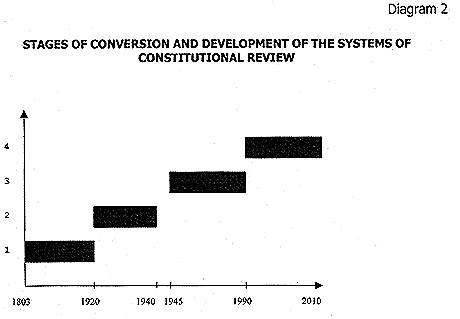
The development of judicial constitutional review in the last two centuries diagramatically may be introduced in the following stages (Diagram 2):
1. 1803-1920
2. 1920-1940
3. 1945-1990
4. Following 1990.
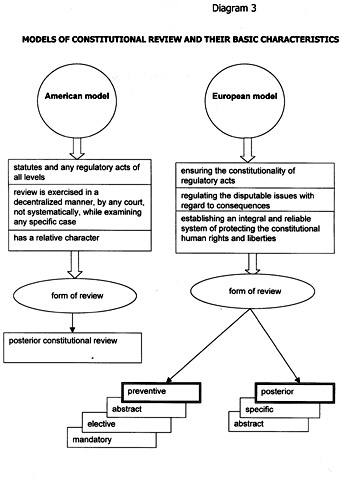
An increasingly great number of countries are adopting the European model of constitutional review, which is stipulated by the need to establish reliable guarantees of stability of social development (Diagram 3).
Operational within the last century throughout the world and currently in many countries, the American model of constitutional review is distinguished by the following basic features:
- universal character, embracing not only the laws but also any regulatory acts of all levels;
- decentralized review, by any court, non-systematically, when hearing any specific case, if the law or regulation is concerned with the specific interests of the plaintiff;
- relative character,
since the court decision is mandatory only for the two parties without
being extended to the whole field of law enforcement.
| Previous |