Chapter I. The Legal Nature, Stages of Development and Functional Characteristics of the Major Models of Constitutional Review
Constitutionality is a political principle which partly finds expression in the normative function of law, partly in real social existence. It entails a mechanism of political relations and powers as well as legal counterweights and guarantees by which the self-interest of power has to be limited. Constitutionality should not be treated statically, because it can change. Therefore we can speak about constitutionality and the constitution as a unique principle which finds complete expression in the written constitution. Material constitutionality is the structural essence of each democratic political system.
The introduction of constitutionality was based on the appropriate level of maturity of sociopolitical circumstances, which finds expression in the consideration of the following principles: the basic rights of humans and citizens, the principle of national sovereignty and the principle of the separation of powers. The principle of constitutionality involves a democratic source of power (the general voting right), the recognition of basic human rights, as well as the organization of the highest State bodies.
The written constitution is, in principle, the most important legal and political remedy for the implementation of constitutionality. Therefore it is necessary for the functioning of each democratic political system that a constitution is implemented. Only in a definitely democratic political system can the implementation of constitutionality and legality be provided. There is no constitutionality without democracy and vice versa.
The objective of extraordinary significance for a harmonic development of society is an operational system of state authority, a prerequisite of mutually agreed activities of the legislative, executive and judiciary authorities, a distinct constitutional delimitation of their authority and review of their administration.
A fundamental value of the society is unquestionably the supremacy of law, ideas and principles of which are targeted against an autocratic rule. The attributes inherent to a state governed by the Rule of Law, i.e. the primacy of law, separation of powers, respect for human rights, accountability of power, democratic rule, et al., date back to classical antiquity.
In a democratic society, the purpose of making laws is to guarantee and implement the human rights and freedoms, with reasonable restrictions on the use of authority, as well as to establish a contingency of challenging the laws at the level of the Constitution, to verify their constitutionality, i.e. their conformity with the law.
Separation of powers, indispensable for a civil society and a democratic state, will in the meantime put forward an objective to retain the constitutionally instilled balance of relationships among different authorities by triggering the relevant mechanisms of deterrents and counterbalances, to provide the dynamism and a sustained social development. This objective is feasible only with an operational full-scale system of constitutional review. Made sure on that point long ago were many countries having a developed statehood as well as the newly emerging democracies.
As underscored by G. Ellinek, to be regarded as legal is only a state where a legislator is subject to law like any other citizen (italics by the authors). S. Kotliarevsky, a renowned Russian jurist, assigned a special role to the establishment of an independent, politically uncommitted court2.
The top principle of existence and functioning of the democratic society and a state governed by the Rule of Law is the supremacy of the Constitution, which is at the same time the principal concept of constitutional review.
Supremacy is an attribute implanted into the Constitution of the topmost common priority of its validity instituting the legal acts hierarchy, which identifies the Constitution as the basis of law making and binding the law-enforcement body.
The basis for this is the nature of the Constitution as a legal act of constituent effect having a common priority in excess of the legal effect of any other prescriptions issued by public authority, inasmuch as this authority is constituted by the Constitution itself.
In order to fulfill this role, the Constitution itself should not be in contravention to the highest principles of Law; it has to incorporate them into itself3. Constitution is the law of justice, rather than a mechanical linkage of accepted statements.
The Constitution is a fundamental legal substance, intended not only to establish the institutes of authority, to ascertain their competence and order of relationships, but rather also to secure the restrictions on the excessive use of power, to envisage such limitations for the state authority that generate a close connection, copartnership and mutual responsibility of the state and person for the administration of society, while mostly taking their origin from everyone's freedom and the aggregated volition of all. The Constitution determines a correlation of powers and the basics of their interrelations aimed at providing a permanent dynamic development of society. The correlation of powers has a discrete nature, while its forms and limits are envisaged by the Constitution, the only manner of its legitimization being the free will of the electorate.
The Constitution is intended to outline the boundaries of law and to provide it with an inherent determinacy. That will in turn advance a contingency to produce a functional institutional system of intra-constitutional auto-protection.
The ultimate will of the union of citizens is configured within the relevant supreme law of the state, binding at the same time, using a legal effect, not only the state being constituted, but also the society constituting the state. This is what amounts to the manifestation of the institutionalizing character of the popular sovereignty, its legal indication being the constitutive will of the citizens providing the inherent legal bond between the social environment and the state, since the latter will never be able to become part of that environment.
The supreme law of a Rule of Law state, having a constitutive force and thus placed above the state itself, as well as the legal basis for the formation and exercise of public authority and state empowerment, by virtue of possessing the attributes of this level of generality and abstraction, that would provide the means, given the absence of protecting devices, to transfer the gravity center of public authority to the legislator, thus replacing law with statute, this supreme law presumes the function of preserving the Constitution as the state governed by the Rule of Law's supreme function having a reviewing character. In actual practice, the social organism will acquire a sort of an immune system of self-protection that will dynamically provide a functional equilibrium of the society. The constitutional review is actually becoming the core of the immune system of the social structure.
The contents and forms of constitutional review are not identical in different legal systems. The constitutional review, a specific function supporting the supremacy of the Constitution, cannot be the main function of the bodies empowered to adopt legal acts, which in turn can become the objects of constitutional review. Therefore, the power to ensure the constitutionality of regulatory acts cannot be entrusted to the parliament. In countries with the constitutional status of the head of state integrated with that of the chief executive, the function of upholding the constitutionality can be charged to this official, however only within the supervision of administrative acts. Thus, the constitutional review can be enforced only by the bodies that, by virtue of their independence from the public authorities can resolve the legal conflicts in the most unbiased way.
This power cannot be enjoyed by the institutes of social structure having legislative or executive functions. Constitutional review is featured within the framework of deterrents and counterbalances, its main purpose being the disclosure, assessment and rehabilitation of the disrupted balance. Constitutional review admits no irrational reproduction of functional violations or accumulation of negative social energy, which by gathering the critical momentum can produce a new quality by explosive means. In actual practice, that amounts to an option between the dynamic, evolutionary or revolutionary development. The constitutional review is called upon to exclude the revolutionary features or social emergencies.
The history of constitutional review counts many centuries. Its character, implementation philosophy, forms and methods, organizational systems have undergone serious changes and are currently in the stage of active improvement. The main idea is that the insurance of harmonic activity of the bodies of state authority is not something invariable, but rather requires continuous review of the system stability. Therefore, the role of constitutional review can be compared with the role of the immune system in the human body. In the social organism, likewise, an emerging immune deficiency may trigger a system collapse from any draught.
The bodies of constitutional review perform this type of role primarily by securing the supremacy of the Constitution, resolving the litigations arising in the system of state authority in respect of jurisdictional disputes, and, not the least important, by establishing guarantees of legal regulation of political conflicts emerging within the society.
In other words, constitutional review is a means and a contingency to ensure the stability of society by consecutive and continuous character of its development. This role is implemented by examining, uncovering, stating and removing the discrepancies with the regulatory acts of the Constitution, in the course of which the bodies of constitutional review are empowered to cancel the uncovered divergences, the determining link among those bodies being the institute of the judicial constitutional review4.
Constitutional review is also an incentive to continuous improvement of the system of state authority and harmonizing coordination of the continuously varying public relations.
Constitutional review generates a taste for state-oriented thinking as well as a needed quality of social consciousness. It plays a serious preventive role, when acting in a distinctly recognized way, it stimulates both the bodies of state authority as well as each individual member of society to the legally and constitutionally acceptable way of life.
The concept of constitutional review is directly associated with the availability of the Constitution, retaining the constitutionally established forms and principles securing the instituted balance of empowerment by different entities of authority, as well as with the assignment of securing the constitutional guarantees of protecting the human and social rights and freedoms. Thus, the principal mission of the constitutional review is to secure the supremacy and stability of the Constitution, to retain the constitutional separation of powers and to guarantee the protection of the constitutionally established human rights and freedoms.
A question will arise: what kind of review of the basic rules of social behavior was there at the time when there was no constitution? Often the example of England is cited where formally there is no institutional system of constitutional review. Does it then mean that the review as a way of retaining the balance defining the public relations is nonexistent? To provide answers to those questions, it is necessary first of all to separate the review, which is in some way formalized and arranged, from the non-systemic or so-called "legally, functionally unregulated review". There is a rightful opinion that in early Christianity the supervision of the authorities was the duty of the Church, it was most probably a moral review over the rulers. A long period of reformation in Western Europe resulted in an understanding that something else is needed rather than moral review. A lengthy search produced a technique of legal review over the authorities5.
The situation radically changed when the laws of social behavior found a constitutional formulation. The logic of development of social life prompted a constitutional and legislative adjustment of state administration, separation of powers and harmonic shaping of their activities, introduction of new system of values to the relationships between the society and personality.
Under this situation, the retention of an adequate system of review over the basic rules of social life necessitates constitutional review as a pledge of a sound and sustainable development of society.
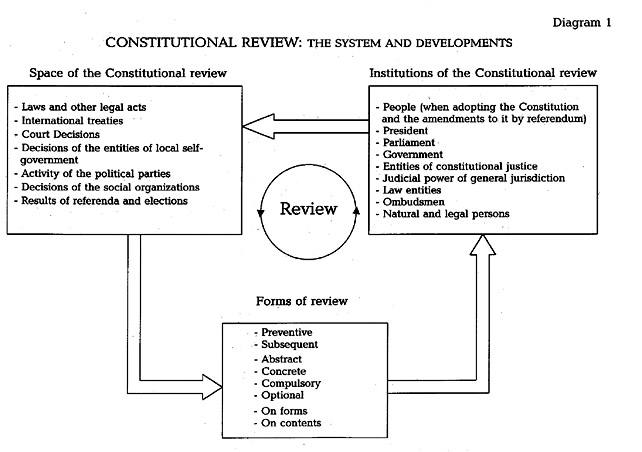
What is then the constitutional review as a system? More often than not many authors circumvent this issue by silence or by identifying it with the judiciary system of judicial review. We shall return to diverse aspects of this issue further on. Two significant points need to be noted here. First of all, the constitutional review is not restricted only by the framework of judicial review. What also needs to be considered is the functional role of the legislative and executive authorities, and the order and traditions of retaining the moral, national and spiritual values. Secondly, the constitutional review, taken as a system, as a totality of complex and harmonically interacting bodies having differing powers, can exist and efficiently function only with certain preconditions. Those having prominence include: the constitutional adjustment of public relations, the establishment of democratic principles of the development of society (this type of system is meaningless at the time of revolutions or dictatorships), independence of review, its universal character, accessibility to the members of the society, openness of the constitutional review, etc. (see Diagram 1).
Of fundamental importance is the condition of the system integrity, explicit functional interconnection between its major components, rational interaction supporting the system dynamic balance, as well as the institutional balance of the system of constitutional review. The study of international experience in the formation and operation of the system of constitutional review in the 20th century, as well as the situations developing in the countries of emerging democracy clearly show that many problems of constitutional review are unfortunately being considered and resolved in a discrete way which does not always produce desirable results. With regard to the particular significance of an efficient system of constitutional review, the following chapters consider this issue from a variety of points.
The development of
different systems of constitutional review can be divided into two major
stages. First: prior to the constitutional regulation of public relations,
when the retention of the rules of social life was not so much an objective
of the legal sphere but rather a problem of ethics, morals, spiritual development
and tradition. Second: within the last two centuries, when the developing
public relations prompted the need to bring the life of the people and
the state to a more orderly condition, when adoption of the Constitution,
recognition of its supremacy and its protection became a fundamental exigency.
That was the way of building a civil society demanding not only a social
accord with regard to the rules of social behavior but an operational system
of protection and review as well.
| Previous |