The Composition/Organisation of Constitutional Courts and Similar Bodies
The introduction of modern constitutional review is based on the principle of the separation of powers and the Constitutional Court as the highest body for the protection of human rights. The Court's jurisdiction and proceedings are specified in detail by a Constitutional Court Act as well as in the rules of procedure adopted by the Constitutional Court itself.
In all new systems of constitutional review the Constitutional Court became the highest body of judicial power for the protection of constitutionality, legality, human rights and basic freedoms.
Most systems of constitutional/judicial review insure the organisational autonomy of the institution. This means they authorize respective constitutional/judicial review bodies to follow their own rules regarding their internal organisation. Most constitutional/judicial review bodies also have an independent budget as a separate part of the whole State budget, and they are fully independent in its control. Services of Constitutional Courts are organised in a similar way: they consist of clerks and clerical staff, and the head of services generally holds the status of secretary general. Each Constitutional Court regulates its own internal organisation in the exercise of its administrative autonomy and in principle it rules its own funds as part of the State budget. The technical services of the Constitutional Court include the office of the General Secretary (concerning matters of organisation and legal knowledge) and the office of the Head of Financial Services (financial organizational matters). The special services of the Constitutional Court also include the Legal Information Centre with its professional library; legal advisers and clerical staff.
The decision-making process may be organised in different ways:
- on the level of a plenary court (in France always);
- on the level of a plenary court and chambers (e.g. Georgia, Germany, Portugal, Slovenia, Spain, Slovenia, Switzerland, where the reason for deciding in chambers involved mostly constitutional complaints; however, in these systems, too, important decisions are made in accordance with the plenary principle);
- on the level of task forces for individual legal domains (Italy).
The Constitutional Court decides in camera sessions or in public hearings.
The normal rule for deciding in the Constitutional Court is by a majority vote of all judges. Exceptions are nonetheless possible. As regards its composition when deciding, usually the Court deliberates in plenum, but it sits in chambers when deciding cases of constitutional complaints.
The number of judges performing the function of constitutional/judicial review differs from country to country, ranging from four (Andorra) or five (Senegal) to sixteen (Germany). As a rule, the appointment procedure for the members of the Court differs from that for the President of the Constitutional Court. The same applies to the duration of their term of office.
The term of office of constitutional court judges lasts between six (Portugal, Burundi), twelve (Germany) or fifteen years (Kyrgyzstan); the average is nine years (which is also the case in Slovenia). The term of office of the members of the Serbian Constitutional Court/the FRY, of the US Supreme Court and of the Armenian Constitutional Court as well as of the Constitutional Court of Tatarstan/Russia is for lqfe. To assure the principle of the (political) independence of Constitutional Court judges, most systems do not allow their re-election. There is a variety of examples of how this is handled: the judges may have life tenure (the USA), they may perform their functions up to a certain age (a maximum of 70 years in Austria, Belgium, Armenia, Bosnia and Herzegovina, Kyrgyzstan and Tatarstan/Russia, 60 years in Tajikistan), or their re-election after a limited term in office is explicitly excluded (France, Germany, Italy). Hungary, Portugal and Switzerland, do envisage the re-election of Constitutional Court Judges, whereas in Spain immediate re-election is forbidden. The reappointment of Constitutional Courts and the frequency of the appointment of Constitutional Court Judges do not coincide; in some countries the term of office of Constitutional Court Judges expires successively, which results in the successive reappointment of a part of the Constitutional Court (Bulgary, France, Romania, Spain). The minimum age acceptable for appointment of a Constitutional Court Judge (40 years) is specified in Germany, Belgium and Slovenia, Georgia (35 years), Armenia (35 years) and Tajikistan (30 years).
The influence of government bodies upon the appointment or elections of Constitutional Court Judges differs from case to case (see Chapter VI).
Most systems recognise the immunity of constitutional court judges and certain systems recognise explicit parliamentary immunity (see Chapter VI).
A special feature of the office of Constitutional Court Judge is its incompatibility with certain activities (see Chapter VI).
The Powers of Constitutional Courts and Other Bodies of Constitutional Review
Powers
From a historical point of view, in many systems constitutional/judicial review emerged in jurisdictional disputes between various government bodies. Due to the fact there are numerous other controversial issues emerging today, constitutional review is no longer concerned only with the distinction of these powers.
The following countries feature the Constitutional Court functions listed:
I. PREVENTATIVE REVIEW:
1. CONSTITUTIONAL PROVISIONS (Moidavia, Switzerland - as regards the canton constitutions, the Central African Republic);
2. INTERNATIONAL TREATIES (Albania, Algeria, Andorra, Armenia, Azerbaidjan, Belarus, Bulgary, Burkina Faso, Burundi, Buryatia/Russia, Cameroon, Cape Verde, the Central African Republic, Chile, Comoros, Congo, Dagestan/Russia, Estonia, France, Gabon, Georgia, Germany, Guatemala, Guinea, Hungary, the Ivory Coast, Karelia/Russia, Kazakhstan, Lithuania, Madagascar, Mali, Moidavia, Poland, Portugal, Russia, Slovenia, Spain, Tajikistan, Tunisia, Ukraine);
3. STATUTES (Afghanistan, Algeria, Austria - as regards the acts of federal entities, Belarus, Burkina Faso, Burundi, Cambodia, Cameroon, the Central African Republic, Chad, Chile, Comoros, Congo, Costa Rica, Cyprus, Djibouti, Ecuador, Finland, France, Gabon, Germany, Guatemala, Guinea, Hungary, Indonesia, Ireland, Italy, Ivory Coast, Kazakhstan, Madagascar, Mali, Mauritius, Morocco, Namibia, Niger, Northern Ossetia/Russia, Peru, Poland, Portugal, Romania, Russia, South Africa, Spain, Sri Lanka, Syria, Thailand, Togo, Tucuman/Argentina, Turkey, Tunisia, Venezuela, Zambia);
4. REGULATIONS (Belarus, Burundi, the Central African Republic, Comoros, Congo, Gabon, Madagascar, Namibia, Northern Ossetia/Russia, Portugal, Tucuman/Argentina);
5. ACTS OF THE HEAD OF STATE (Algeria, Guinea, Madagascar);
6. ACTS OF TERRITORIAL UNITS (South Africa);
7. OTHER REGULATIONS:
BUDGET ACTS, PARLIAMENTARY INTERNAL REGULATIONS (Belarus, Burundi, Cameroon,
the Central African Republic, Chad, Comoros, Cyprus, Djibouti, France,
Madagascar, Niger, Romania, Thailand,Togo).
II. REPRESSIVE (A POSTERIORI) REVIEW:
1. ABSTRACT REVIEW:
a) Concerning- the Constitution, constitutional amendments, or basic constitutional Provisions (Baden-Wuerttemberg/Gennany, Brazil, Costa Rica, Cuba, Cyprus, Dagestan/Russia (the constitutions of administrative units), the FRY (the conformity of the Constitution of constituent republics with the Constitution of the Federal State); Kyrgyzstan, Rheinland-Pfalz/Germany, Russia (constitutions of federal entities), Saarland/Germany, Turkey, Ukraine, Uzbekistan (the conformity of the Constitution of the Republic of Karakalpakstan with the Constitution of Uzbekistan);
b) International agreements (including agreements between the Federal State and federal entities) (Adigea/Russia, Afghanistan, Austria, Azerbaidjan, Bashkiria/Russia, Cameroon, Chad, Comoros, Congo, Costa Rica, Greece, the Kabardino-Balkar Republic/Russia, Latvia, Liechtenstein, Lithuania, Madagascar, Mauritania, Moldova, the Philippines, Russia, Senegal, Tatarstan/Russia, Tuva/Russia, Uzbekistan, Yakutia/Russia);
c) Statutes (Adigea/Russia, Afghanistan, Albania, Algeria, Angola, the Argentinean Province of Tucuman, Armenia, Austria, Azerbaidjan, Baden-Wuerttemberg/Gennany, Bashkiria/Russia, Bavaria/Germany, Belgium, Benin, Berlin/Germany, Bolivia, Bosnia and Herzegovina, Brazil, Bulgary, Buryatia/Russia, Cambodia, Cameroon, Cape Verde, Chad, Chile, Colombia, Congo, Comoros, Costa Rica, Cuba, Croatia, the Czech Republic (and the subsidiary power of the Supreme Court), Cyprus, Dagestan/Russia, Ecuador, Egypt, El Salvador, Equatorial Guinea, Eritrea, Estonia, the FRY, the FYROM, Georgia, Germany, Guatemala, Greece, Hamburg/Germany, Hessen/Germany, Honduras, Hungary, lrkutskaya Oblast/Russia, Italy, the Kabardino-Balkar Republic/Russia, Karelia/Russia, Komy/Russia, Kuwait, Kyrgyzstan, Latvia, Lebanon, Liechtenstein, Lithuania, Madagascar, Malawi, Malaysia, Mauritania, Mauritius, Moldova, Mongolia, Montenegro/the FRY, Mozambique, Namibia, Nicaragua, Niedersachsen/Germany, Nordrhein-Westfalen/Germany, Northern, Ossetia/Russia, Palestina, Panama, Paraguay, Peru, the Philippines, Poland, Rheinland-Pfalz/Germany, Russia, Rwanda, Saarland/Germany, Senegal, Serbia/the FRY, the Serbian Republic of Bosnia, the Seychelles, Slovakia, Slovenia, South Africa, South Korea, Spain, Sudan, Syria, Taiwan, Tajikistan, Tatarstan/Russia, Tuva/Russia, Turkey, Uganda, Ukraine, Uruguay, Uzbekistan, Karakalpakstan/Uzbekistan, Venezuela, Zaire, Zambia, Yakutia/Russia, Yemen);
cl) Resolutions of the Parliament (Latvia, Armenia);
d) Regulations (Adigea/Russia, Afghanistan, Albania, Angola, Austria, Azerbaidjan, Buryatia/Russia, Cape Verde, Comoros, Congo, the Czech Republic, Dagestan/Russia, Ecuador, Egypt, El Salvador, Eritrea, the FRY, Georgia, Guatemala, Hungary, Irkutskaya Oblast/Russia, the Kabardino-Balkar Republic/Russia, Karelia/Russia, Komy/Russia, Kuwait, Latvia, Liechtenstein, Lithuania, Madagascar, Mauritania, Moldova, Mongolia, Montenegro/the FRY, Mozambique, Northern Ossetia/Russia, South Africa, Panama, the Philippines, Poland, Russia, Serbia/the FRY, the Serbian Republic of Bosnia, Slovakia, Slovenia, Sudan, Tajikistan, Tatarstan/Russia, Tucuman/Argentina, Ukraine, Uzbekistan, Karakalpakstan/Uzbekistan, Yakutia/Russia, Yemen);
e) Acts of the Head of State (Adigea/Russia, Algeria, the Argentinean Province of Tucuman, Armenia, Azerbaidjan, Bashkiria/Russia, Bulgary, Buryatia/Russia, Ecuador, El Salvador, Georgia, Latvia, Lithuania, Madagascar, Moldova, Mongolia, Northern Ossetia/Russia, Panama, the Philippines, Russia, Tajikistan, Tatarstan/Russia, Ukraine, Uzbekistan, Karakalpakstan/Uzbekistan, Yakutia/Russia, Yemen);
f) Rules and other acts of national administrative units (federal member states, (autonomous) Provinces, local communities, etc.) (Azerbaidjan, Bashkiria/Russia, Buryatia/Russia, Cyprus, Dages ussia, the FRY, Georgia, lrkutskaya Oblast/Russia, Karelia/Russia, Komy/Russia, Latvia, Northern Ossetia/Russia, Serbia/the FRY, Slovakia, Slovenia, Spain, Russia, Tajikistan, Ukraine, Uzbekistan, Yakutia/Russia);
g) Proclaimed regulatory measures of statutory authorities (Slovenia);
h) The confonniiy of national legal norms with international agreements (Albania, Bulgary, the Czech Republic, the FRY, Hungary, Latvia, Poland, Slovakia, Slovenia);
i) Regional agreements/the agreements of constituent republics closed with the Federal State (Buryatia/Russia, Dagestan/Russia, lrkutskaya Oblast/Russia, the Kabardino-Balkar Republic/Russia, Karelia/Russia, Komy/Russia).
j) Other rules (Austria, Bolivia, Croatia, Ecuador, the FYROM, Hungary, the Kabardino-Balkar Republic/Russia, Madagascar, Mali, Northern Ossetia/Russia, the Philippines, Poland, Tajikistan, Serbia/the FRY, Slovakia, Slovenia, Turkey, Uganda);
2. CONCRETE REVIEW - SPECIALIZED CONSTITUTIONAL/JUDICIAL REVIEW BODIES REQUESTED BY ORDINARY COURTS (Adigea/Russia, Austria, Azerbaidjan, Bashkiria/Russia, Bavaria/Germany, Bremen/Germany, Bulgary, Buryatia/Russia, Cambodia, Cape Verde, Congo, Costa Rica, Croatia, Cuba, the Czech Republic, Cyprus, Dagestan/Russia, Djibouti, Estonia, Gabon, Georgia, Germany, Guatemala, Hamburg/Germany, Honduras, Hungary, Iran, Italy, Karelia/Russia, Kazakhstan, Komy/Russia Kyrgyzstan, Lithuania, Madagascar, Malaysia, Malta, Niedersachsen/Germany, Niger, Panama, Paraguay, Poland, Romania, Russia, the Seychelles, Slovenia, South Africa, South Korea, Spain, Taiwan, Thailand, Togo, Uruguay, Zambia, Yakutia/Russia).
III. THE INTERPRETATION OF RULES (as an interpretative function):
1. CONCERNING THE CONSTITUTION (Adigea/Russia, Albania, Azerbaidjan, Bashkiria/Russia, Bulgary, Burundi, Buryatia/Russia, Cambodia, Dagestan/Russia, Eritrea, Gabon, Germany, Hungary, lrkutskaya Oblast/Russia, Kazakhstan, Komy/Russia, Kyrgyzstan, Madagascar, Moldova, Namibia, Niger, Papua New Guinea, Russia, Slovakia, Sri Lanka, Sudan, Taiwan, Uganda, Uzbekistan, Zaire, Yakutia/Russia);
2. CONCERNING STATUTES AND OTHER RULES ( Azerbaidjan, Cambodia, Dagestan/Russia (in relation to federal legislation), Egypt, Equatorial Guinea, France, Indonesia, Madagascar, Palestine, Poland, Sudan, Taiwan, Uzbekistan).
IV. THE IMPLEMENTATION OF RULES - DECIDING ON MATTERS RELATING TO THE CONFORMITY OF A RULE'S IMPLEMENTATION WITH THE CONSTITUTION (Bashkiria/Russia, Ecuador, Irkutskaya Oblast/Russia, the Kabardino-Balkar Republic/Russia, the Philippines Rheinland-Pfalz/Gerinany, Russia, Tuva/Russia).
V. THE OMISSION OF (STATUTORY) REGULATIONS - LEGAL GAPS (Brazil, Hungary, Italy, Portugal, the Seychelles, Uganda).
VI. (CITIZEN'S) LEGISLATIVE INITIATIVES:
1. CITIZEN'S INITIATIVES (Austria, Hungary, Romania, Spain);
2. CONSTITUTIONAL COURT LEGISLATIVE INITIATIVES (Adigea/Russia, Bashkiria/Russia, Burundi, Buryatia/Russia, Dagestan/Russia, the Kabardino-Balkar Republic/Russia, Karelia/Russia, Komy/Russia, Northern Ossetia/Russia, Tatarstan/Russia, Tuva/Russia, Yakutia/Russia);
3. PARTICIPATION IN THE LEGISLATIVE PROCEDURE (the Central Affican Republic).
VII. JURISDICTIONAL DISPUTES:
1. BETWEEN TOP GOVERNMENT BODIES (Adigea/Russia, Albania, Andorra, Austria, Azerbaidjan, Baden-Wuerttemberg/Germany, Bashkiria/Russia, Bavaria/Germany, Berlin/Germany, Bremen/Germany, Bulgary, Buryatia/Russia, Cameroon, the Central African Republic, Chad, Croatia, Cyprus, Dagestan/Russia, Ecuador, El Salvador, the FRY, the FYROM, Gabon, Georgia, Germany, Guatemala, Hamburg/Germany, Hessen/Germany, Irkutskya Oblast/Russia, Italy, the Kabardino-Balkar Republic/Russia, Karelia/Russia, Kazakhstan, Komy/Russia, Madagascar, Mali, Mongolia, Mozambique, Nicaragua, Niedersachsen/Germany, Niger, Nordrhein-Westfalen/Germany, Peru, Poland, Russia, Saarland/Germany, Senegal, the Serbian Republic of Bosnia, Slovakia, Slovenia, Spain, South Africa, South Korea, Taiwan, Tajikistan, Tatarstan/Russia, Thailand, Ukraine, Yakutia/Russia);
2. BETWEEN THE STATE AND REGIONAL OR LOCAL UNITS (Adigea/Russia, Albania, Austria, Bashkiria/Russia, Bosnia and Herzegovina, Brazil, Bulgary, Buryatia/Russia, Cameroon, the Central African Republic, the Czech Republic (and the subsidiary power of the Supreme Court), Dagestan/Russia, the FRY, the FYROM, Germany, Hungary, India, lrkutskaya Oblast/Russia, Italy, Karelia/Russia, Komy/Russia, Madagascar, Malaysia, Mexico, Montenegro/the FRY, Nicaragua, Nigeria, Pakistan, Russia, the Serbian Republic of Bosnia, Slovenia, South Affica, South Korea, Spain, Switzerland, Tatarstan/Russia, Ukraine, Yakutia/Russia);
3. BETWEEN LOCAL OR REGIONAL UNITS (Austria, Bashkiria/Russia, Bolivia, Bosnia and Herzegovina, Brazil, Buryatia/Russia, Cameroon, the FRY, Germany, lrkutskaya Oblast/Russia, Italy, Karelia/Russia, Komy/Russia, Mexico, Montenegro/the FRY, Nicaragua, Nigeria, Peru, Russia, Slovenia, South Africa, South Korea, Spain, Switzerland, Tatarstan/Russia, Tucuman/Argentina, Ukraine);
4. BETWEEN THE COURTS AND OTHER GOVERNMENT BODIES (Austria, Egypt, Greece, Montenegro/the FRY Serbia/the FRY, Slovenia, Tucuman/Argentina);
5. OTHER SPECIFIC JURISDICTIONAL DISPUTES (Austria, Croatia, Cyprus, Hungary, Nicaragua, Tucuman/Argentina, Ukraine, Yakutia/Russia, Yemen);
6. BETWEEN THE CONSTITUTIONAL COURTS OF THE CONSTITUENT REPUBLICS OF THE FEDERATION (the FRY).
VIII. POLITICAL PARTIES - DECISIONS RELATED TO MATTERS OF UNCONSTITUTIONAL ACTS AND ACTIVITIES (Albania, Armenia, Azerbaidjan, Bashkiria/Russia, Bulgary, Burkina Faso, Chile, Croatia, the Czech Republic, the FRY, the FYROM, Georgia, Germany, Moldova, Montenegro/the FRY, Poland, Portugal, Romania, Russia, Serbia/the FRY, the Serbian Republic of Bosnia, Slovakia, Slovenia, South Korea, Yakutia/Russia).
IX. REFERENDA - DECISIONS REGARDING A REFERENDUM'S CONFORMITY WITH THE CONSTITUTION(Algeria, Armenia, Austria, Berlirt/Gemiany, Burkina Faso, Cameroon, Chad, Chile, Comoros, Congo, Croatia, Djibouti, Equatorial Guinea, France, Gabon, Georgia, Greece, Hessen/Gen-nany, Hungary, Ivory Coast, Kazakhstan, Madagascar, Mali, Mauritania, Moldova, Mongolia, Montenegro/the FRY, Mozambique, Niger, Nordrhein-Westfalen/Germany, Portugal, Romania, Saarland/Germany, Slovakia, Slovenia, Zaire).
X. ELECTIONS - DECISIONS REGARDING THE CONFORMITY OF ELECTION PROCEEDINGS WITH THE CONSTITUTION AND STATUTES (Albania, Algeria, Armenia, Austria, Baden-Wuerttemberg/Germany, Bavaria/Germany, Berlin/Gennany, Bulgary, Burkina Faso, Burundi, Cambodia, Cameroon, the Central African Republic, Chad, Comoros, Congo, Croatia, the Czech Republic, Cyprus, Djibouti, Ecuador, Equatorial Guinea, France, the FRY, Gabon, Georgia, Germany, Greece, Guinea, Hamburg/Germany, Ivory Coast, Kazakhstan, Kyrgyzstan, Lebanon, Lithuania, Madagascar, Mali, Malta, Mauritania, Mauritius, Moldova, Mongolia, Montenegro/the FRY, Morocco, Mozambique, Namibia, Niedersachsen/Germany, Niger, Nigeria, NordrheinWestfalen/Germany, Portugal, Rheinland-Pfalz/Germany, Romania, Saarland/Gerinany, Serbia/the FRY, Slovakia, Sri Lanka, Syria, Togo, Tucuman/Argentina, Zaire, Yemen).
XI. THE CONFIRMATION OF THE ELECTION OF REPRESENTATIVES (Austria, Baden-Wuerttemberg/Germany, Bavaria/Gennany, Berlin/Germany, Bulgary, Chile, France, Georgia, Germany, Greece, Hamburg/Germany, Kazakhstan, Mongolia, Niedersachsen/Germany, Nordrhein-Westfalen/Germany, Saarland/Germany, Slovakia, Slovenia, Ukraine).
XII. THE PROTECTION OF HUMAN RIGHTS (constitutional complaints and similar constitutional remedies):
1. HUMAN RIGHTS PROTECTION (Adigea/Russia, Albania, Andorra, Austria, Azerbaidjan, Bavarian/Germany, Bashkiria/Russia, Benin, Berlin/Gennany, Brazil, Bremen/Germany, Burundi, Buryatia/Russia, Cape Verde, Colombia, Congo, Croatia, the Czech Republic, Cyprus, Dagestan/Russia, Djibouti, Ecuador, El Salvador, Equatorial Guinea, the FRY, the FYROM, Georgia, Germany, Guatemala, Hessen/Germany, Honduras, Hungary, Israel, the Kabardino-Balkar Republic/Russia, Karelia/Russia, Komy/Russia, Kyrgyzstan, Liechtenstein, Montenegro/the FRY, Mali, Malta, Mauritius, Mongolia, Nicaragua, Panama, Papua New Guinea, Poland, Russia, Saarland/Germany, Senegal, Slovakia, Slovenia, South Africa, South Korea, Sudan, Spain, Sri Lanka, Switzerland, Syria, Taiwan, Tucuman/Argentina, Ukraine, Uzbekistan);
2. CONSTITUTIONAL COMPLAINTS REQUESTED BY COMMUNITIES (Baden-Wuerttemberg/Germany, the Czech Republic, Germany, Nordrhein-Westfalen/GeiTnany);
3. CITIZENS' LEGISLATIVE INITIATIVES (Spain, Saarland/Gerinany);
4. NATIONALISATION(Rheinland-Pfalz/Germany, Saarland/Gennany).
XIII. CAPACITY TO HOLD THE OFFICE:
1. CONCERNING THE HEAD OF STATE (Adigea/Russia, Algeria, Armenia, Azerbaidjan, Bashkiria/Russia, Bulgary, Burundi, the Central African Republic, Croatia, Cyprus, France, Kazakhstan, Kyrgyzstan, Lithuania, Mauritania, Moldova, Mozambique, Poland, Portugal, Romania, Yakutia/Russia);
2. CONCERNING OTHER STATE REPRESENTATIVES (Bulgary, Cyprus, France, Russia, Yakutia/Russia);
3. ACCEPTING THE OATH OF THE HEAD OF STATE UPON ASSUMING OFFICE (Burundi).
XIV. IMPEACHMENT:
1. CONCERNING THE HEAD OF STATE/OR A MEMBER STATE OF THE FEDERATION (Adigea/Russia, Albania, Algeria, Armenia, Austria, Azerbaidjan, Bashkiria/Russia, Bolivia, Bulgary, Buryatia/Russia, Chile, Colombia, Croatia, the Czech Republic, Dagestan/Russia, Eritrea, the FYROM, Georgia, Germany, Hungary, lrkutskaya Oblast/Russia, Ireland, Italy, the Ivory Coast, Karclia/Russia, Kazakhstan, Komy/Russia, Lithuania, Madagascar, Mongolia, Montenegro/the FRY, Namibia, Russia, Rwanda, Slovakia, Slovenia, Tatarstan/Russia, Turkey, Ukraine, Yakutia/Russia);
2. OTHER STATE REPRESENTATIVES (Austria, BadenWuerttemberg/Gerinany, Bavaria/Gennany, Bolivia, Bremen/Germany, Bulgary, Comoros, Dagestan/Russia, Georgia, Italy, South Korea, Karelia/Russia, Komy/Russia, Lithuania, Mongolia, Niedersachsen/Germany, Nordrhein-Westfalen/Germany, Rheinland-Pfalz/Germany, Saarland-/Germany, Slovenia, Taiwan, Tucuman/Argentina, Turkey, Ukraine).
XV. SPECIAL POWERS (VIOLATIONS OF INTERNATIONAL LAW, DECISIONS RELATING TO THE APPOINTMENT OF CONSTITUTIONAL COURT JUDGES AND THEIR IMMUNITY, OPINIONS RELATING TO THE DECLARATION OF MARTIAL LAW, THE IMPLEMENTATION OF DECISIONS ISSUED BY INTERNATIONAL COURTS, PROPOSALS FOR THE AMENDMENT OF THE CONSTITUTION, CONSULTATIVE FUNCTIONS, ETC.) (Afghanistan, Algeria, Armenia, Austria, Berlin/Germany (membership in the Richterwahlausschuss); Bulgary, Burundi, Cambodia, Chad, Cuba, the Czech Republic, Cyprus, Egypt, France, Gennany, Hamburg/Gemiany (Representafives Rights), the Ivory Coast, Mauritania, Moldova, Russia, Spain, Sri Lanka, Togo, Uzbekistan (concerning the dissolution of the Parliament, or the approval of a Head's of State decision)).
XVI. OTHER TASKS
WHICH THE COURT IS CHARGED WITH BY THE CONSTITUTION OR STATUTES
(Adigea/Russia, Azerbaidjan, Baden Wuerttemberg/Germany, Bashkiria/Russia,
Bavaria/Gerinany, Berlin/Germany, the Central African Republic, Chile,
Croatia, Dagestan/Russia, Ecuador, the FYROM, Georgia, Germany, Guatemala,
Hamburg/Germany, Hessen/Germany, Komy/Russia, Montenegro/the FRY, Nicaragua,
Niedersachsen/Gennany, Nordrhein-Westfalen/GeiTnany, Portugal, Rheinland-Pfalz/Germany,
Slovenia, South Africa, Spain, Tajikistan, Tuva/Russia, Turkey, Ukraine,
Uzbekistan).
Particular Components of Constitutional Court Powers:
IN PREVENTATIVE (A PRIORI) REVIEW of constitutional provisions, international treaties signed by a particular country, statutes and other legislative acts, regulations and some other rules, the constitutional/judicial review body has in fact a consultative function, when on the demand of a petitioner (mostly privileged government bodies) it discusses a rule and issues the corresponding decision prior to the promulgation of a rule or its enforcement. Such power is held by the Constitutional Court of Italy with reference to provincial statutes; by the Constitutional or High Courts of Austria, Germany and Chile; (especially) by African systems following the French model; by Portugal, Ireland, Finland, Cyprus, Hungary, Romania, Syria, Turkey, Poland, Russia (only with reference to certain statutes), and until 1985 also by Spain. On the international level, this form of constitutional review has been subject to much criticism; in particular on the occasion of the abolishment of the preventative review in Spain, numerous weaknesses were pointed out: that the legislature neglects its own constitutional review, that in this way legislative procedure is delayed, that due to the short terms provided for, this review is questionable anyway. The preventative review provided by the French Constitutional Council applies mainly to statutes. Except for France and certain African countries, which are not familiar with the repressive review of statutes and executive regulations, but practice a wide preventative review of statutes, no country has adopted any pure system of preventative review.
REPRESSIVE (A POSTERIORI) REVIEW is applicable to the rules in force and has been adopted by most systems. Certain systems, however, tend to combine the essentially repressive review with the preventative review of the international treaties signed by the particular country; a few other systems practice a combination of the preventative and repressive review of other rules (Cyprus, Romania). Repressive review may be abstract or specific. In individual systems both forms may appear individually or jointly. Abstract (direct) review may refer to constitutional provisions, international treaties signed by a particular country, statutes, regulations, presidential decrees, legislative acts and other rules of administrative units as well as to some other categories of rules. It may be introduced independently of the proceedings in a specific case, on the basis of applications lodged by specially qualified petitioners. The abstract review is, in comparison with other forms, less frequent; its importance lies in the fact that it deals with theoretical questions relating to constitutional law. Constitutional Court Judges are concerned only with the question of the constitutionality of the rule as the main dispute; this may require the cessation of an unconstitutional rule or a declaratory dispute. The latter may also be of a preventative character. Cassation itself may have an ex tunc effect (annulment, setting aside) or an ex nunc effect (abrogation). Hence, cessation (of statutes) involves two versions: from the point of view of the authority of statute and the principle of notice, the cessation of a statute is supposed to take effect only following the adoption of a decision of the Constitutional Court onwards - an ex nunc effect (as in Austria). An abrogated statute represented the legal basis for issuing individual acts until its abrogation. From the point of view of the standing of the aggrieved citizens (parties) and the principles of equity and legality, the cessation of a statute is supposed to function retrospectively from the time of the adoption of the rule - ex tunc (as in Germany) - an unconstitutional statute cannot have any legal effect at all and it is necessary to "repair" everything that had been done on the grounds of an unconstitutional statute. A decision issued by the Constitutional Court has a retroactive effect going back to the adoption of the rule, as if the rule were erased from the legal system. The nullity of such an act is identified by the Constitutional Court only in a declaratory way. Nevertheless, this nullity cannot negate the fact that the respective statute was in force for a certain time and that legal affairs were regulated on that respective basis. In both cases individuals have the right to require the modification of individual acts issued on the respective basis.
SPECIFIC (CONCRETE, INDIRECT, ACCESSORY) REVIEW of rules arises out of proceedings in progress before an ordinary court which, however, has to be convinced of the unconstitutionality of a certain rule (Germany), or that the court's doubt about the unconstitutionality of the rule not be obviously unfounded (Italy). This approach envisages judicial review by an ordinary court whereby the Constitutional Court is relieved of its immediate duties (the character of a prejudicial question). The consequence of this review is that an unconstitutional rule (statute) is not applied to a specific dispute. The accessory constitutional review of a statute is rooted in the American system wherefrom it spread particularly into certain countries of the American continent and elsewhere. With a specific constitutional review the Constitutional Court issues decisions concerning the constitutionality and legality of legal measures as a prejudicial question and not a disputed individual act, as is the case with the constitutional complaint.
We have performed a comparative analysis of recruitment and functioning of over 150 institutes of specialized or centralized constitutional review.
The principal institutes are:
- Constitutional Courts (in Europe and most parts of the New Independent States);There is an interesting feature in Portugal: there is a Constitutional Court, but the functions of constitutional review is also exercised by the courts of general jurisdiction. On cases of constitutional review, the Constitutional Court performs the function of a higher court. That is actually an interesting combination of the two models.
- Constitutional Councils (France, Morocco, Mozambique, Kazakhstan, etc.);
- Constitutional Chambers of Supreme Courts (Burkina Faso, Guinea, Costa Rica, Estonia).
In some countries the institutes of constitutional review have specific characteristics for the relevant country only. A typical example is the system of constitutional review in the Islamic Republic of Iran. Here, according to Art. 91 of the Constitution, this function is performed by the Guardian Council, consisting of 12 members: 6 representatives of the clergy and 6 law experts, with a term of office of 6 years. The representative composition is changed once in three years. The forms of review are preliminary and mandatory. That means that all laws are presented by the Parliament to the Council, to be reviewed within 10 days for their agreement with the Islamic rules and the Constitution, and in case of a misstatement to be returned to the Parliament for reformulation. Incidentally, the issue of the draft being relevant to the Islamic rules is decided by members of the Council representatives of the clergy.
That body had also received the right to interpret the Constitution: with the consent of three-fourths of its members (Art. 98). It will also regulate the legality of the presidential and parliamentary election (Art. 99).
Of exclusive importance for carrying out an independent and efficient activities of the Constitutional Courts, is the procedure of its recruitment. The following noteworthy issues are to be singled out here:
a) what is the procedure
of recruitment of the members of the court?
b) for what term are
the members of the court elected?
c) what are the requirements
to the members of the court?
The members of the body of constitutional review are mainly appointed (or elected) by different branches of authority. However, in international practice there are different options of approaches. Eg., in Hungary, Poland, Peru, Slovakia, Germany, Latvia, all members of the body of the constitutional review are appointed by the Parliament. In Austria, Albania, Armenia, France, Benin, Kirgizstan, Romania they are nominated by the President and the Parliament.
In Bulgary, Gabon, Italy, Spain, Lithuania, Madagascar, Moldova, Ukraine, Mongolia, Turkey, Korea, they are appointed by the President, the Parliament and the institutes of judicial authority (ie. provision is made for the participation of all three branches of authority).
In contrast to the courts of general jurisdiction, members of the Constitutional Court can be not only experienced judges, but also teachers of law, civil servants, political figures, among them non-lawyers. In some countries, the number of non-lawyers is defined by law: in Gabon 2 of 9 (Art. 89 of Gabon's Constitution), in Sweden 113 of the total number of judges. In Uzbekistan, for example, Art. 12 of the law "On Constitutional Court" states that a member of the Constitutional Court is elected from among specialists in political science and law having high moral qualities and the necessary qualification. And, Art. 194 of the Polish Constitution states: The Constitutional Tribunal consists of 15 judges elected individually by the Sejm for 9 years from among the persons prominent in the knowledge of law.
There is an interesting feature in Turkey, where both the lawyers and people having certain experience of state-administrative work can be elected.
In some countries, the constitutional review is exercised by the courts of general jurisdiction, and this function can be performed by all those who have qualities for being nominated for parliamentary election. In Switzedand, e.g., Art. 108 of the Constitution reads that to be a member of the Federal Court, one has to be a citizen of Switzerland having the right to be elected to the National Council. This is a typical example of a country, where the activity of the body effecting the constitutional review mainly covers the disputes in constitutional law, and, naturally, the issues of constitutional laws and decisions by the bodies of state authority (Art. 110 of the Swiss Constitution).
In Belgium, the members of entities of constitutional review can be not only judges and professors of law, but also persons who had been members of parliament.
In France, however, there are no limitations for members of the Constitutional Council along the line of professions.
According to some theorists, engagement of specialists from other fields into the specialized body of constitutional review ( in particular from politics, philosophy, social sciences, etc.), as well as recruitment of experienced persons and VIPs having worked in the sphere of state administration, offers great advantages and benefits.
A similar exigency was commented upon by Hugo Bluff, a member of US Supreme Court (he was nominated in 1937 by Franklin Roosevelt, and worked for 34 years, until he died in 1971). He thought that a nomination of a non-lawyer as a member of the Supreme Court gives him a larger charge of freedom, since he had overcome the psychology of dependence prompted by the logic of hierarchical career.
Also important is the argument that here we deal not so much with the technology of the application of law or another legal act, but rather with the philosophy of review and regulation of public relations, while the situation of law-creation and the ability to master it becomes the primary objective.
From the viewpoints of both institutional and functional independence of bodies of constitutional review, the issues of office term and removability of members should be anaiyzed separately. The practical approaches are different. Firstly, there are countries where the independence of constitutional review is ensured by electing the members of that entity by the principle of irremovability (USA, Austria, Denmark, Armenia, etc.).
Another set of countries think that the term of office should be limited (it is commonly fluctuating between 5 and 15 years). Germany, France, Italy, Spain, Turkey, etc. are among those countries. Envisaged in those countries is a mechanism of rotation (commonly once in three years).
Nearly all countries also have identical solutions in recruitment of their Constitutional Courts. That is primarily in relevance to some requirements to the members of the Court. Firstly, they cannot do any other paid work (with the excepton of research, teaching and artistic activity in some countries). Secondly, a member of a constitutional review entity cannot be a member of a political party or engaged in political activities (in many countries the law forbids the members of a constitutional review body to be a member of a trade-union or another non-governmental organization). Thirdly, even if the nomination is not done following the principle of irremovability, persons over 65-70 or under 35-40, as a rule are not nominated or elected as members of the Court. Besides, in nearly all countries they enjoy the status of immunity, and take an oath prior to entering office. Incidentally, in most countries only the court can dismiss its member from office, as provided by law (Aibania, Bulgary, Germany, Latvia, Portugal, Romania, Switzerland, Turkey, etc.).
In another group of countries, the body that appointed the Court members provides the final solution on the basis of the Court ruling (Siovakia, Armenia, Macedonia, etc.). In Finland, Japan, the USA, Latvia, removal of a judge is done in a special order of impeachment.
A number of countries, when recruiting the institutes of constitutional review, attach a special significance to linguistic competence. Switzerland and Canada, in particular, with the number of the state languages more than one, elect the members of the Supreme Court with regard to the proportions of linguistic groups. In Canada, for example, three judges of the Supreme Court have to be natives of Quebec and have experience of practical work in civil law, and six members in common law.
There are interesting differences in the problem of electing the chair of the entity of constitutional oversight.
The election is done as follows:
a) Court, autonomously
(Bulgary, Romania, Benin, Hungary, Italy, Mongolia, Congo, Portugal, Russia,
Moldova, Georgia, etc.);
b) the head of state,
unadvised (Algeria, Egypt, Morocco, Mauritania, Kazakhstan, France, etc.);
c) parliament (Germany,
Armenia, Latvia, Kirgizstan);
d) President, by presentation
from the Government (Austria);
e) President, with
agreement from the Parliament (Republic of Korea).
To boost the efficiency of constitutional review and with regard to the administrative-territorial structure of the country, particular attention is also paid to the organization structure of the bodies of constitutional review.
In case of multi-chamber courts, the law prescribes the formation of chambers, hearing and decision-making procedures, circumscribes the hearing and decision-making procedures for issues in the exclusive competence of the plenary sessions of the Court.
However, this division has also a functional character, enabling to consider and decide individual issues within the constituency of a part of the Court members. This situation is more frequent when the body of constitutional review is provided with powers inherent to a certain degree to the courts of general jurisdiction and is restricted by time frame. In Armenia this issue is not fully resolved and can result in a serious deadlock. The matter is that, on the one hand, the Constitutional Court is bound to produce a decision within a period of 30 days (Art. 102 of RA Constitution), on the other hand, it is bound to resolve the dispute in full membership with regard to the parliamentary election results (Art. 100, Clause 3), with their number incidentally reaching several hundred. This type of deadlocks, as will be shown below, is usually resolved either by easing the time-limits, or, even in single-chamber courts, by affording a number of judges (usually 3-5) the right to examine cases and take decisions.
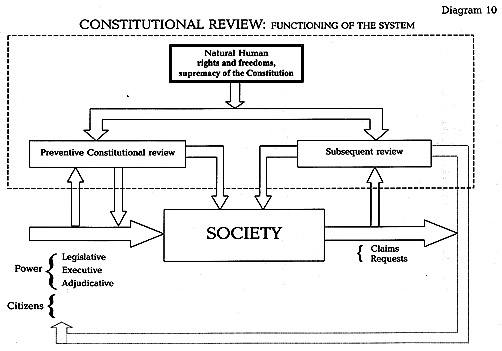
The features of recruitment of the bodies of constitutional review have a common basic characteristic that an objective is set with regard to the character of public relations and the targets of development of any country to establish a body, that would not be politically influenced and have high morality, that would be able to ensure the supremacy of the Basic Law of the country, facilitate a stable and dynamic development of the society with regard to the particular system of values in a particular society (see Diagram 10 for the functioning of the system of constitutional review).
In different countries, the specialized bodies executing the constitutional review, the Constitution and laws are confronted with different objectives, naturally following from the specific functions of the said bodies. These objectives are essentially as follows:
retaining the balance of separation of powers, prevention of the misuse of power, application of deterrents and counterbalances review of its activities (in many countries, e.g. France, the Rules of Procedure of the Chambers is subject to preventive review);
The total review as a rule is inherent to the American model, the limited one to the European. However, that is conditional. Meanwhile, in the US the object of constitutional review is any legislative or administrative act disputed within the judicial inquiry of a civil or criminal case.
In many countries of Europe, the round of powers of the bodies of Constitutional Courts is almost all-embracing (Austria, Portugal, Poland, Germany). For example, in Poland the Constitutional Tribunal resolves not only the issues of constitutionality of laws, but also of acts by the central and local bodies.
The objects of constitutional review also include acts by the bodies of local self-government (Slovakia, Slovenia, the Czech Republic).
Many characteristics are also featured in federal and unitary states. In the former case, constitutional review has to ensure the supremacy of federal interests. Therefore, the objects of review are also the regulatory acts of the federal subjects.
In a number of countries, there are laws overstepping the limits of constitutional review. For example, in Turkey the laws adopted at the time of emergence of the republic as well as the decrees having the force of laws and adopted during emergencies or martial law (Art. 174 and 148 of the 1982 Constitution).
The question of whether the constitutional laws and laws adopted by referendum are objects to constitutional review is disputable.
There is a viewpoint that neither the acts of this type, nor the Constitution can be object of constitutional review. On the other hand, there is an argument that the object of constitutional review is the Constitution, since it contains the regulations having a fundamental significance. For example, Art. 114 of the Constitution of the Republic of Armenia provides that Art. 1, 2 and 114 are not subject to change. Moreover, constitutions of many countries contain regulations adjusting the features for applying individual articles or constitutional provisions. It is to be added that any legal document, even if it is not a subject of material or conceptual review, is bound to become such in its form or the subject of formal review.
In a number of countries (e.g. Romania, Kirgizstan), the constitutional amendments prior to be adopted by the Parliament are presented to the Constitutional Court, and only in case of a positive opinion of the latter they can be further promoted (the Constitutional Court of Romania has to provide a ruling within 10 days (Arts. 13 and 37 of the Constitution). There is a similar procedure in Moldova: Arts. 135 and 141.
In a number of countries, the Constitutional Court has the right to advance the legislative initiatives (Uzbekistan, the Law "On the Constitutional Court", Art. 10). Most remarkable is the fact that when constitutional amendments are proposed, they are considered by the Constitutional Court within the framework of the system of preliminary mandatory review.
With regard to the forms and methods of review, a distinction is made between the categories of constitutional "review" and "control" (supervision). Those two concepts are frequently confused or considered identical when mentioned in references149.
We lean to the opinion that in the case of review, e.g., the reviewing subject has the right to nullify the act.
As to the control (supervision), it has a passive character, needed to draw attention or make a proposition, while suspension of the act's validity or its nullification remains within the competence of another body or the one that had adopted that act. Using this approach, the constitutional control (supervision) can be defined as an activity for checking, uncovering and stating the nonconformity to the Constitution of all other legal acts. However, elimination of such non-conformities lies beyond the competence of the body of constitutional control (supervision).
We also disagree with unequivocal statements that the supreme constitutional control (supervision) in all states is effected by the parliament150. The parliament mostly exercises the function of mere constitutional review, while the oversight functions are more coherent with the institute of the ombudsman151.
A typical example within the series of the institutes of constitutional control (supervision) is also the institute of the Chancellor of the Justice in Estonia. However, this question has a wider scope. The matter is that, as has been already noted, the set of subjects of constitutional review is vast, with many of them charged with the function of control (supervision) rather than review towards the legal acts, within their constitutional or law-provided powers.
As has been noted, at the present time in the world, there are over a hundred specialized entities of constitutional review (including the constitutional courts of subject states, in Russia and Germany, in particular). They are charged with over thirty powers, the most prominent being: ascertaining the constitutionality of legislative acts, specific review over the protection of human rights, interpretation of the Constitution, resolving disputes arising between different branches of authority in respect of jurisdictional disputes, determining the constitutional character of official and political organizations, resolving disputes on election results, etc.
With regard to the set of functional range, all constitutional courts can be classified into 3 groups:
1. Those implementing 15 principal powers (a typical example is Austria, Russia and the Constitutional Courts of a number of countries, having an integral system of constitutional review).
2. Implementation of 1 - 15 principal powers (Germany, Hungary, Georgia, Azerbaijan, etc.)
3. Those having up to 10 powers.
Incidentally, Armenia is related to the states leaving beyond the framework of constitutional review such exclusive powers as the preliminary review - of laws (effected in 46 countries), interpretation of the Constitution and of the laws (42 countries), resolution of disputes emerging between different branches of authority in respect of jurisdictional disputes (between central branches of authority - 43 countries, between the territorial and other bodies - 60 countries), the direct protection of human rights (52 countries), etc. In countries having integral constitutional systems, out of the listed ones 1 or 2 powers may be lacking. Besides, omission of the mentioned set of powers will modify the functional role of the body of constitutional review, providing it mainly with the function of a council: this type of body, in turn, will require another structure and operational mechanisms.
The only power effectuated by the constitutional courts of all countries with no exception is the issue of constitutionality of laws (within the framework of preventive or ex post facto review).
A comparative analysis of the experience gained by over one hundred countries effecting the constitutional review through specialized bodies, will result in a number of general statements of which the following have to be particularly emphasized:
1. A system of constitutional review cannot be integral or efficient with no specific review and no direct protection of human rights.
2. Beside making the constitutional review unhealthy, no access to powers on the interpretation of the constitution and resolution of disputes emerging between different branches of authority in respect of jurisdictional disputes will result in unavoidable social disturbances, to potential accumulation of unsolved problems and their explosive resolution.
3. There exists an organic link between the powers (or objects of review) and the set of subjects having the right to appeal to the Constitutional Court. If, however, restrictions are extended not only to the powers, but also to the circle of appealing subjects, resulting in the array of available powers becoming practically unfeasible, then the system of constitutional review is not in a position to fulfil its mission.
| Previous |